Are Solar Panels Worth It in Washington DC?
Last Updated: November 18, 2026
Quick Summary
Solar panels are often worth it in Washington, DC, but the answer depends on system size, price, and your utility's net metering credits. A 9.52-kilowatt dc solar panel system averages $30,465 installed, or about $3.18 per watt. Compare quotes per watt and ask installers for projected monthly savings based on your actual utility rate.
- A 9.52-kilowatt system averages $30,465 installed in the District.
- Compare installer quotes using the price per watt, not just the total.
- Net metering credits offset grid power, so savings depend on your utility's rules.
- Income-eligible residents may qualify for no-cost solar through Solar for All.
- Get a shade and roof assessment, since historic and rowhouse rules can affect installation.
Table of Contents
- What a Washington DC Solar Panel System Costs Today
- How DC Solar Net Metering Affects Your Monthly Savings
- Solar for All DC Eligibility and No-Cost Options
- Roof Suitability, Shade, and Whether Your House Qualifies
- DC Solar Panel Installation Permits and Interconnection Steps
- Choosing an Installer and Comparing Quotes Before You Sign
- Your Next Step: Get a Site-Specific Solar Estimate
- Frequently Asked Questions
What a Washington DC Solar Panel System Costs Today
If you are asking whether solar panels are worth it in Washington, DC, start with the price. According to EnergySage local solar panel cost data for Washington, DC, a 9.52-kilowatt system averages $30,465 installed, with listed prices ranging from $25,895 to $35,035. The same source lists a local average of $3.18 per watt, so the total depends heavily on system size.
Solar pricing in the District is quoted in two ways, and both are worth understanding before you compare offers.
Per-Watt Pricing and Typical System Sizes
Installers often quote solar in cost per watt. City Renewables' 2026 analysis of DC solar economics
Per-watt pricing makes it easier to compare quotes that use different system sizes. A larger system usually lowers the per-watt cost, but it also raises the total bill. Ask every installer for the system size in kilowatts, the price per watt, and the total before you compare.
Why Two Quotes Can Differ by Thousands
Two quotes for the same house can differ by thousands of dollars. Common reasons include panel brand and efficiency, inverter type, roof work, electrical upgrades, and whether the price includes permits and monitoring. A quote that looks cheaper may leave out items that another installer includes.
Compare line items, not just the bottom line. A quote that does not name the equipment or the warranty terms is harder to trust.
The article's cost figures can be scanned side by side.
| Item | Value | Note |
|---|---|---|
| Example system size | 9.52 kW | Average installed system cited |
| Average installed price | $30,465 | Local average for that size |
| Listed price range | $25,895 to $35,035 | Varies by installer |
| Local average per watt | $3.18 | Use to compare quotes of different sizes |
How DC Solar Net Metering Affects Your Monthly Savings
Net metering determines how much your system saves each month. Under net metering, excess electricity your panels send to the grid earns credits that offset what you pull from the grid later. Your savings depend on how your utility sets those credits and on how much power your home uses.
The District's solar policy also matters. The DC Department of Energy & Environment describes a solar-energy carve-out that rises from 5% to 10% by 2041 under the Clean Energy DC Omnibus Act of 2018. DC Department of Energy & Environment guidance on solar in the District
Before you sign, ask your installer to show projected monthly savings using your actual utility rate and your usage history.
Solar for All DC Eligibility and No-Cost Options
The DC Sustainable Energy Utility describes its Solar for All program as providing eligible residents with solar energy solutions at no cost. DC Sustainable Energy Utility Solar for All program page
Eligibility rules and program availability can change. Check the program's current requirements directly. Explore Washington, D.C. solar incentives, SRECs and tax credits to see how the District's programs fit together.
Program rules change, so verify current income limits and application windows with the program administrator before you plan around them.
Roof Suitability, Shade, and Whether Your House Qualifies
Roof direction, shade, and structural condition all affect output, but in the District the housing stock adds constraints that a generic solar guide will not mention. A south- or west-facing roof with good sun exposure usually performs best, and heavy tree shade can cut production sharply. Before you commit, walk your roof the way an assessor would.
Orientation and tilt. South-facing planes produce the most annual energy; east- and west-facing planes produce less but can still pencil out, especially when paired with time-of-use rates. Flat roofs can be tilted toward the south with racking, which is common on commercial and some multifamily buildings.
Shade. Trees, chimneys, dormers, and neighboring rowhouses all cast shade that changes with the season. Winter shade from a leafless tree is milder than summer shade from a full canopy, but a tall evergreen can cut production year-round. An on-site shade scan or a satellite-based shade estimate is more reliable than eyeballing it from the ground.
Roof age and condition. Solar panels typically last 25 years or more, so the roof underneath should have comparable remaining life. If your roof is near the end of its service life, most practitioners recommend replacing it before installation rather than paying to remove and reinstall the array later. Asphalt shingle, standing-seam metal, and flat membrane roofs each have different mounting approaches and different penetrations.
Rowhouses and shared roofs. Many District homes are rowhouses with party walls, shared roof structures, and sometimes shared or adjacent roof access. If you own the roof over your unit, you can usually proceed, but confirm the property lines and any easements. If the roof is a shared common element, you will likely need approval from the other owners or the condominium or cooperative association before any penetration is made.
Historic districts and design review. Homes in designated historic districts or individually landmarked properties may need design review before a building permit is issued. Reviewers commonly focus on visibility from the street, panel placement, and equipment screening. A solar installer who has worked in historic districts will know what documentation the review expects.
Structural capacity. Most modern roofs carry the added load of a residential array without reinforcement, but older roofs, heavy tile, and roofs with previous modifications may need an engineering review. Ask the installer whether a structural assessment is included.
Sierra Club analysis estimates that about 125 megawatts of solar capacity could fit across rooftops, parking lots, and building facades in the District. Sierra Club Solar Report v8 on DC solar potential That figure describes aggregate potential, not your roof. Your own roof may or may not be a good candidate, and an on-site assessment is the only way to know for sure.
Use Check your roof's sun exposure with Solar Roof Score to see annual sun hours and usable roof area for your address before you request a quote.
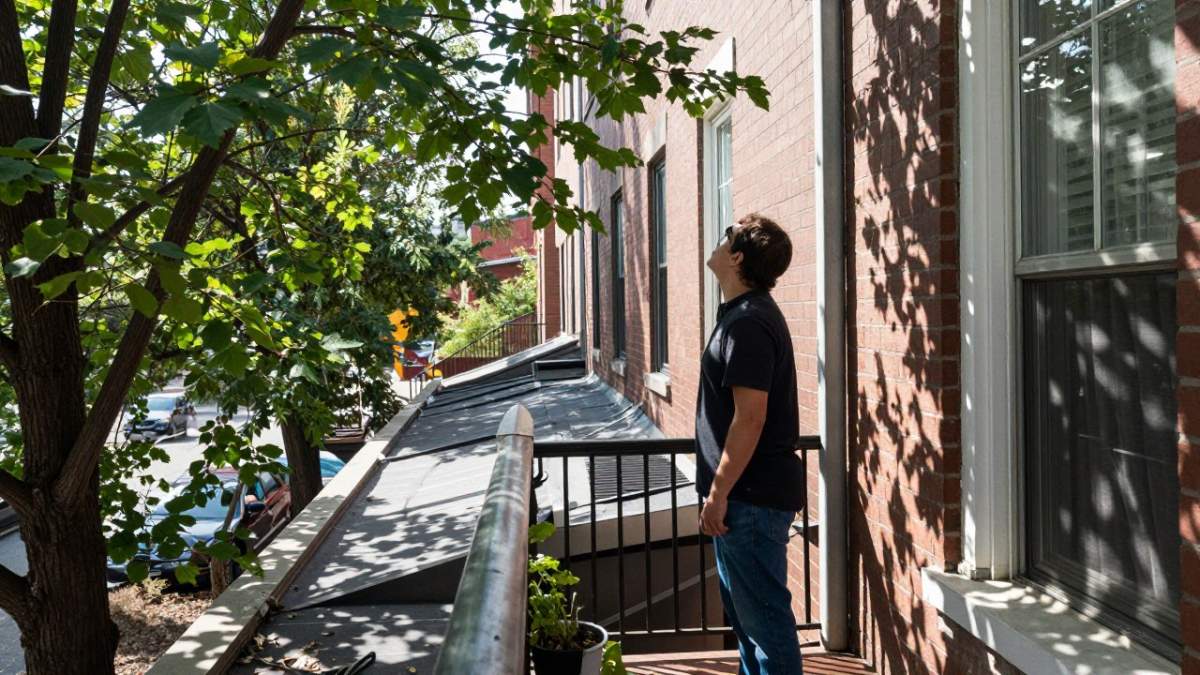
!A homeowner in a Washington DC row house standing on a sunlit back patio, looking up at the rooftop with a tree partially shading one corner
Watch out: an installer who quotes from satellite imagery alone without confirming roof age, rafter condition, and historic-district status can produce a price that changes once the crew arrives.
DC Solar Panel Installation Permits and Interconnection Steps
Permitting and interconnection are where most local solar projects lose time, and they are the two steps a national quote template rarely explains. Residential solar installations generally require permits and a utility interconnection application before the system can be energized, and requirements should be verified with the District and your utility. Installers commonly file these applications, but the homeowner's responsibilities should be confirmed in writing before work begins, so it pays to know the sequence.
A common pattern for a District residential install runs in this order:
- Site assessment and structural review. The installer confirms roof condition, rafter spacing, and whether the home sits in a historic district or is subject to a homeowners association review. Rowhouses and homes in historic districts can require an additional review before a building permit is issued.
- Building and electrical permit application. The installer submits plans and load calculations to the District's building permit authority. Plan review timelines vary with project complexity and review backlog; simple residential rooftop systems often move faster than projects that include structural reinforcement or main panel upgrades.
- Utility interconnection application. Your distribution utility reviews the system for grid safety and approves the interconnection. The application typically requires a single-line diagram, equipment specifications, and the inverter's listing details. Approval is what legally allows the system to export power.
- Installation. Crews install racking, panels, inverter, and any electrical upgrades. If the project includes a main panel upgrade or service change, that work is usually inspected separately.
- Inspections. A local electrical inspection and, where required, a building inspection confirm the work matches the approved plans. The utility may also require its own inspection or meter exchange.
- Permission to operate. The utility issues permission to operate, the meter is swapped or reprogrammed, and the system begins generating and earning net-metering credits.
Watch out: a quote that says "permits included" without naming who pulls them, who pays the fees, and who schedules inspections can leave you responsible for a step you did not budget for.
Ask every installer for a written permit and interconnection timeline with the following items spelled out:
- Which permits they will pull and which, if any, you must pull yourself
- Whether permit and interconnection fees are inside the quoted price
- Who prepares the single-line diagram and equipment specifications
- Who schedules the electrical and building inspections
- The expected interval between installation and permission to operate
- What happens if the utility requires a meter upgrade or a study
Timelines are not fixed, and treat any installer who promises a guaranteed activation date with caution. A realistic plan builds slack into the schedule and tells you which step is currently the bottleneck.
Choosing an Installer and Comparing Quotes Before You Sign
We recommend collecting at least three written quotes. Look for these items in each one:
- System size in kilowatts and price per watt
- Total price, with and without permits and interconnection fees
- Panel and inverter brands, plus the warranty length for each
- Roof work and electrical upgrades included or excluded
- Projected monthly savings based on your utility rate
Be cautious of quotes that rely on vague savings estimates or leave out installation details.
If you want a clear comparison of local options, request a free, no-pressure solar quote for your Washington, D.C. home.
Your Next Step: Get a Site-Specific Solar Estimate
Solar economics come down to your roof, your usage and your utility rate. Start with a site-specific estimate so you know what your own home would produce and save. Go Solar DMV can help you compare options across Virginia, Maryland and Washington, DC, and our AI Solar Advisor and quote comparison audit can help you evaluate them.
Frequently Asked Questions
Are solar panels worth it in DC?
For many DC homeowners, solar can be worth it, but the answer depends on your roof's sun exposure, your electricity usage, the system price you are quoted, and how long you plan to stay in the home. Pricing depends on your home's specifics, so compare a site-specific quote against your current electric bills before deciding. Go Solar DMV can model your specific roof with Google Project Sunroof 3D irradiance data to estimate production.
How much do solar panels cost in DC?
Total cost scales with system size, roof complexity, and equipment choices. Pricing depends on your home's specifics, so the most reliable figure comes from a site-specific quote. Visit Go Solar DMV's website to request an estimate based on your roof and usage.
Are there any ways to get free solar panels in Washington DC?
Eligibility for any government program depends on program criteria, which can change, so check current requirements directly with the program administrator. Go Solar DMV's platform offers systems installed and maintained at no cost, subject to the terms of your agreement.
What permits and approvals are needed to install solar panels in DC?
A residential installation generally requires permits and a utility interconnection application so your system can connect to the grid under net metering, and requirements should be verified with the District and your utility. Your installer usually prepares these filings, but you should confirm who is responsible for each step in writing. Requirements can change, so verify current rules with the District and your utility before signing a contract.
