How to Choose a Solar Battery Storage Option in Maryland
Last Updated: October 31, 2026
Quick Summary
A maryland solar battery system stores daytime solar power for evening use and can provide backup during outages. Your best choice depends on whether you retrofit an existing array (AC-coupled) or design new solar with storage (DC-coupled), plus usable capacity, power output and available state incentives.
- Price batteries per usable kWh, not nameplate capacity, to compare quotes fairly.
- AC-coupled systems are simpler to add to an existing solar array later.
- Confirm the battery's continuous power output can run your essential appliances.
- Maryland's energy storage rebate program and state tax credit may lower your cost.
- Ask your utility about interconnection approval before installation starts.
Table of Contents
- Why Maryland Homeowners Are Adding Solar Batteries
- Maryland Solar Battery Storage Options for Homes
- Maryland Home Battery Cost and What Drives the Price
- Maryland Solar Battery Incentives and Tax Credits
- How Much Battery Capacity Your Home Needs
- Adding a Battery to an Existing Solar System
- Booking a Battery Assessment With Go Solar DMV
- Frequently Asked Questions
Maryland homeowners are adding batteries to their solar systems at a steady pace, and the state's policy direction explains much of the momentum. Go Solar DMV has built this guide to help you sort through the battery storage options available to a Maryland home, from how the systems are wired to what they cost and which incentives may apply. Batteries are no longer a niche add-on, and the right choice depends on your roof, your utility bill and how much backup power you want.
Why Maryland Homeowners Are Adding Solar Batteries
Most Maryland solar owners are asking one question: what does a battery actually do for me? A battery stores solar energy produced during the day so you can use it in the evening, when electricity is often most expensive. The state's Maryland Energy Administration consumer guide to solar describes this role clearly.
State support is also shaping the decision. The Maryland Energy Administration's Residential and Commercial Energy Storage Program provides rebates toward the cost of buying, installing and interconnecting battery storage. Check the program's current status before you plan a purchase, since availability changes by fiscal year.
Maryland Solar Battery Storage Options for Homes
Home battery systems generally fall into a few categories based on how they connect to your solar equipment and the home's electrical panel. The right fit depends on whether you are adding a battery at the same time as new solar or retrofitting an existing array.
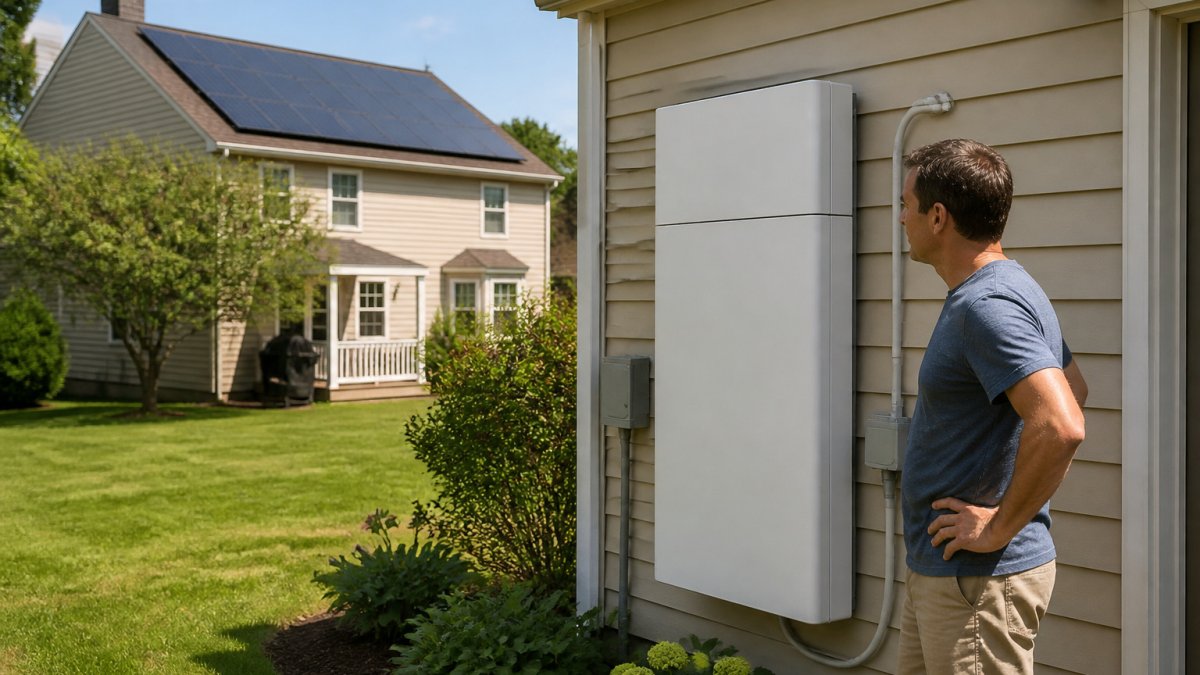
Some systems are built around a specific brand's battery and inverter, while others let you mix components. Compare warranties, usable capacity and whether the battery can keep working during an outage. A battery that cannot island from the grid will not help during a blackout, even if it stores plenty of energy.
AC-Coupled vs. DC-Coupled Systems
The coupling type determines how the battery connects to your solar panels, and it matters most when you add storage to a system that already exists.
| Feature | AC-Coupled | DC-Coupled |
|---|---|---|
| Connection point | Battery has its own inverter, tied to the home's AC circuit | Battery connects to solar on the DC side before one shared inverter |
| Best for | Retrofitting an existing solar array | New installations designed together |
| Typical efficiency | Slightly lower due to extra conversions | Often higher because energy stays in DC longer |
| Installation | Simpler to add later | Usually planned at the time of installation |
AC-coupled systems are easier to add later because they do not require changing your existing solar inverter. DC-coupled systems can be more efficient when designed from the start, but retrofitting one usually means replacing the inverter.
Maryland Home Battery Cost and What Drives the Price
Battery pricing is the question homeowners ask first, and the honest answer depends on quantity, specifications, and installation requirements rather than a single number. For current pricing, request a quote from Go Solar DMV.
Comparing quotes on a per-kilowatt-hour basis of usable capacity lets you evaluate offers of different sizes. A quote that looks cheaper may reflect less usable capacity, a shorter warranty, or excluded electrical work.
What Actually Moves the Price
- Usable capacity (kWh). This is the biggest driver. Battery manufacturers often advertise total capacity, but the usable figure, after depth-of-discharge limits, is what runs your home. A 13.5 kWh nameplate unit may deliver closer to 13.5 kWh usable, while some chemistries reserve more headroom. Always price per usable kWh.
- Power output (kW). A battery that stores a lot but discharges slowly cannot run a well pump, electric range, or heat pump startup. Higher continuous and peak output usually costs more.
- Coupling and inverter work. Retrofitting an AC-coupled battery to an existing array is often simpler and cheaper than replacing a DC-coupled inverter, but it adds a second inverter and slightly lower round-trip efficiency. A DC-coupled design planned with new solar can be more efficient but usually requires replacing the existing inverter on a retrofit.
- Electrical upgrades. A critical-load subpanel, a main service panel upgrade, a transfer switch, or moving circuits all add labor and material. Older homes with 100-amp service or full panels see the largest add-ons.
- Permitting and interconnection. Local permits and the utility's interconnection review add both fees and calendar time. Requirements differ by utility territory, and a battery added to an existing solar system can trigger a fresh review.
- Labor and access. A garage wall mount is quick; a detached garage, a crawlspace run, or a long conduit path is not.
A Realistic Incentive-Adjusted View
Start with the installed quote, then subtract any storage rebate or state income tax credit you qualify for, and apply any federal residential clean energy credit your system and timing may qualify for. The order matters: rebates typically reduce the out-of-pocket basis, and tax credits are calculated on what remains, so confirm the sequencing with a tax professional rather than assuming the discounts simply stack.
Interconnection is the schedule risk, not just a cost line. Your utility must approve the system before it can be energized, and a battery change to an existing solar account may require a new application. Ask early how your utility handles storage approvals and how long its queue is running.
Payback in Plain Terms
Payback depends less on the sticker price than on how the battery is dispatched. A battery that shifts solar production into expensive evening hours, or that charges on off-peak rates and discharges on-peak, earns value every day. A battery that mostly sits as outage insurance earns value only when the grid fails. Most households see a mix, and the honest payback estimate models both. A system that offsets $60 to $120 a month in evening and demand-charge savings behaves very differently from one that saves nothing until a storm. Ask for the savings model in writing, with the rate assumptions shown.
Maryland Solar Battery Incentives and Tax Credits
Maryland offers more than one way to lower the cost of a battery, and the programs can change. The state provided a state income tax credit for energy storage starting in 2022, and Morgan Lewis's 2026 review of state energy storage policy describes it as one of the state's active storage incentives.
Rebate programs may offset part of the purchase, installation and interconnection costs. Federal incentives may also apply to residential storage, so review current guidance with a tax advisor. Keep receipts and permit records, since most incentive claims require documentation.
How Much Battery Capacity Your Home Needs
Sizing is where most homeowners get talked into either too much battery or too little. The right size depends on three separate questions, and conflating them is the most common mistake: how much energy you use after the sun goes down, how much power your backed-up circuits draw at once, and how your utility pays you for what the battery does.
Step 1: Energy, the Kilowatt-Hour Question
Pull a recent utility bill and find your daily kilowatt-hour use. Then estimate the share that falls in the evening and overnight window when solar is not producing, commonly somewhere between a third and half of daily use for a typical household, higher in winter and for homes with electric heat.
That is a starting point, not an answer. A battery sized only to evening load will not carry you through a multi-day outage, and a battery sized for a week of autonomy will be far more expensive than the bill savings justify.
Step 2: Power, the Kilowatt Question
Capacity tells you how long a battery lasts; power output tells you what it can start. A battery with plenty of kilowatt-hours but modest continuous output may not run a heat pump, well pump, or electric dryer, especially at startup. This is why essential-load panels exist: they isolate a defined set of circuits, refrigerator, furnace blower, internet, a few lights and outlets, so a modest battery can carry the loads that matter without trying to run the whole house.
| Approach | What it backs up | Typical battery implication |
|---|---|---|
| Essential-load backup | Selected circuits on a subpanel | Smaller battery and lower cost; runtime depends on which circuits you include |
| Whole-home backup | Entire service panel | Larger battery and higher power output; often requires a service upgrade |
| Bill-management only | Evening and peak-hour load | Sized to daily arbitrage, not outage duration |
Step 3: Rate Plan, the Question Competitors Skip
How your utility pays for battery dispatch changes the economically correct size. Under a time-of-use rate, a battery that charges on cheap off-peak power and discharges during the expensive window earns value daily, and the optimal size tracks your peak-period usage. Under a demand-charge rate, more common on some commercial and rural residential tariffs, the battery's job is to shave the monthly peak, and a smaller battery with high power output can outperform a larger, slower one.
A Worked Example
A home using 30 kWh a day, with about 12 kWh in the evening and overnight window, and a peak draw of roughly 5 kW when the heat pump, well pump, and kitchen appliances overlap, is a common profile.
A site assessment should model both scenarios using your roof orientation, shading, and actual usage pattern. Oversizing adds cost without adding value; undersizing leaves you buying from the grid during the hours you most wanted to avoid. The goal is the smallest system that reliably does the job you actually care about.
Adding a Battery to an Existing Solar System
Adding storage to a solar array you already own is common, and it is usually more involved than it looks. Start by confirming your current inverter supports battery integration. If it does not, you will either add an AC-coupled battery with its own inverter or replace the inverter entirely.
Expect a new interconnection application with your utility. Some utilities require a new review for any change to a solar system, so check requirements before the installer starts work. If your system was installed under an older net metering arrangement, ask how the battery affects your credits.
Booking a Battery Assessment With Go Solar DMV
If you are weighing a battery for a Maryland home, the best next step is an assessment built around your actual roof, usage and utility rate. Go Solar DMV offers a comparison of quotes using our Google Project Sunroof 3D irradiance modeling and our AI Solar Advisor. Visit book a battery assessment with Go Solar DMV to learn more about how Go Solar DMV can help you choose storage that fits your home and budget.
Frequently Asked Questions
What solar battery storage options are available for Maryland homes?
Maryland homeowners typically choose between wall-mounted lithium-ion home batteries paired with a new or existing solar array, and AC-coupled or DC-coupled configurations. Lithium-ion is the most common chemistry for residential storage. The right choice depends on whether you are adding storage to new solar or retrofitting an existing system, and on how much backup power you want during outages. Go Solar DMV can help compare configurations based on your home and utility rate plan.
Are there incentives for installing a home battery in Maryland?
Storage rebates and tax credits may be available for battery purchases. Program funding, eligibility and amounts change, so confirm current availability before you commit to a purchase.
How long does a home solar battery last?
Battery lifespan depends on chemistry, cycling frequency, depth of discharge and operating temperature. Warranties for residential lithium-ion batteries commonly cover a set number of years or throughput limits, so compare the warranty terms of each product rather than relying on a single lifespan figure. Ask any installer for the warranty documents and the expected capacity retention at the end of the warranty period.
