Residential Solar Panel System Cost Breakdown
Table of Contents
- Understanding Residential Solar System Cost
- Average Residential Solar System Cost by System Size
- Solar Panel Installation Cost Breakdown
- Solar Panel Cost Per Watt and Pricing Factors
- Battery Storage Costs and Long-Term Maintenance
- How to Compare Solar Panel Installation Quotes
- Solar Panel Payback Period and Return on Investment
- Frequently Asked Questions
Last Updated: October 10, 2026
Understanding Residential Solar System Cost
A residential solar panel system cost breakdown determines whether solar makes financial sense for your home. Understanding what drives price differences helps you evaluate quotes accurately.
A residential solar panel system cost breakdown includes five major categories: solar panels, inverter and balance-of-system equipment, installation labor, soft costs like permitting, and optional battery storage. System size in kilowatts directly determines panel quantity and scales all other costs proportionally.
Average Residential Solar System Cost by System Size
A typical residential solar system costs $8,000-$25,000 before incentives. Cost per watt ranges from $2.50-$3.50, varying by state and installer.
System size drives total cost linearly: doubling kilowatt capacity roughly doubles installed price.
Here's what typical system sizes cost:
| System Size | Typical Kilowatt-Hour Annual Production | Estimated Installed Cost Range |
|---|---|---|
| 3 kW | 3,600-4,200 kWh | $7,500-$10,500 |
| 5 kW | 6,000-7,000 kWh | $12,500-$17,500 |
| 8 kW | 9,600-11,200 kWh | $20,000-$28,000 |
| 10 kW | 12,000-14,000 kWh | $25,000-$35,000 |
These ranges reflect installed prices before applying federal tax credits or state incentives. Your actual cost depends on roof condition, electrical upgrades needed, and local labor rates.
Solar Panel Installation Cost Breakdown
Sample Itemized Quote for a 5 kW System
| Line Item | Quantity/Size | Unit Cost | Total | % of System |
|---|---|---|---|---|
| Solar Panels (400W each) | 13 panels | $300-$350 | $4,000-$4,550 | 28-30% |
| Inverter (string inverter, 5 kW) | 1 unit | $2,200-$2,800 | $2,200-$2,800 | 15-18% |
| Racking and Mounting Hardware | Complete system | $800-$1,200 | $800-$1,200 | 5-8% |
| Electrical Equipment (conduit, breakers, disconnects, grounding) | Complete system | $1,200-$1,600 | $1,200-$1,600 | 8-10% |
| Installation Labor (roof work, electrical, testing) | 40-60 hours | $50-$75/hour | $2,000-$4,500 | 13-30% |
| Permitting and Inspections | Local fees | Varies | $800-$1,500 | 5-10% |
| Interconnection Application and Engineering | Utility filing | Varies | $300-$800 | 2-5% |
| Overhead and Profit | System-wide | , | $1,000-$2,000 | 7-13% |
| Total Installed Cost (Before Incentives) | , | , | $12,300-$18,950 | 100% |
| Federal Tax Credit (30%) | , | , | -$3,690-$5,685 | , |
| Net Cost After Federal Tax Credit | , | , | $8,610-$13,265 | , |
This reflects typical regional pricing for standard pitched-roof installations with good sun exposure and no major electrical upgrades. Your actual quote varies based on roof condition, system size, equipment choices, and local labor rates.
Solar Panel and Equipment Costs
Solar panels are a significant component of the total installed cost.
Panel efficiency ranges 18-22% for residential panels. Higher efficiency panels produce more power per square foot, useful if roof space is limited or partial shade exists. With adequate roof space, standard-efficiency panels offer better value.
Most manufacturers offer 25-year performance warranties (80% output after 25 years) and 10-year equipment warranties. Established manufacturers have similar warranty structures.
Mounting hardware and wiring are also part of equipment costs. Quality racking prevents water damage and roof leaks. Verify your quote specifies the racking manufacturer and uses stainless steel hardware to prevent corrosion.
Installation Labor and Soft Costs
Labor is a significant part of the total installed price.
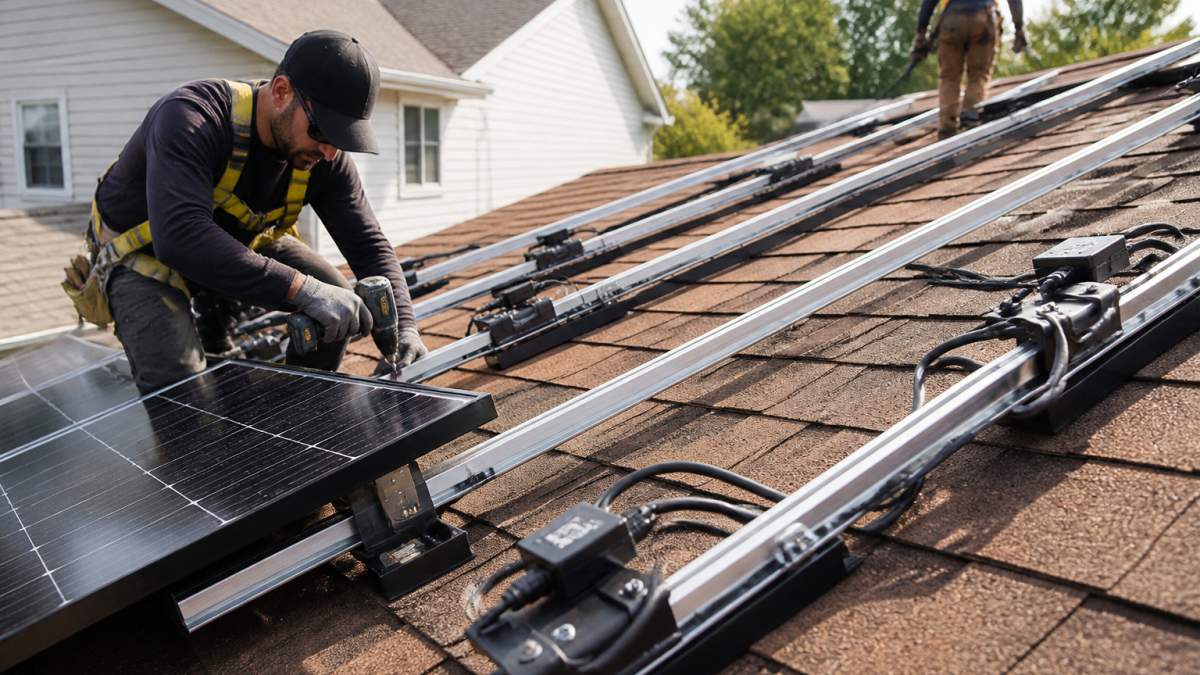
Installation includes roof penetrations, flashing, electrical connections, grounding, and system testing. Ask your installer to specify estimated labor hours and hourly rate to verify quote competitiveness.
Soft costs, permitting, inspections, interconnection, and engineering, are also part of your bill and vary dramatically by jurisdiction. Virginia, Maryland, and D.C. each have their own timelines and fees for these processes.
Inverters, Racking, and Balance-of-System Equipment
The inverter converts DC power from panels into AC power your home uses.
String Inverters manage all panels as a group, are most common, and cost less than microinverters. However, shade on one panel reduces entire string output. Ideal for unshaded roofs with consistent sun exposure.
Microinverters cost $400-$500 each ($5,200-$6,500 for 13 panels), roughly double string inverter cost. They optimize each panel individually, so shade on one panel doesn't affect others.
Hybrid Inverters cost $3,500-$5,000 and manage solar production and battery charging. Only necessary if you plan battery storage.
Inverter warranties typically run for a period of years with optional extensions. Most may require replacement around year 12-15, so factor this into long-term budgets.
Racking systems secure panels and are part of equipment costs. Quality matters significantly: poor racking causes water intrusion and roof damage. Verify your quote specifies the racking manufacturer and uses stainless steel bolts and flashing.
Electrical equipment, conduit, breakers, disconnects, grounding, and safety switches, is also a component of the total cost.
Solar Panel Cost Per Watt and Pricing Factors
Factors That Affect Installation Cost
Cost per watt varies based on installer experience, equipment quality, and local labor rates. Experienced contractors typically price higher but deliver better workmanship and warranty support.
Roof age and condition significantly impact labor costs. A roof nearing end-of-life may require replacement before solar installation, which would add to your project cost.
Electrical panel capacity affects costs. Insufficient capacity may require upgrades before system connection.
Roof Condition and Site Complexity
A south-facing roof with minimal shade and good structural condition is ideal. Complications like west-facing orientation, tree shade, roof penetrations, or structural issues add cost and reduce performance.
Shade analysis is critical. Even partial shade on a few panels can reduce system output by 15-25%. Detailed shade modeling predicts actual energy production before installation.
Roof penetrations for plumbing, HVAC vents, or skylights require careful conduit routing and add labor time. Flat roofs cost more than pitched roofs due to different racking and waterproofing requirements.
Battery Storage Costs and Long-Term Maintenance
Battery storage systems provide backup power during outages. Batteries require replacement every 10-15 years.
System maintenance is minimal but real. Panel cleaning every 6-12 months improves output by 2-5%. Inverter replacement typically occurs around year 10-12. Electrical connections require inspection every 5 years to prevent corrosion and safety issues.
Most residential systems degrade at roughly 0.5% per year, meaning a 10-year-old system produces about 95% of its original output. This degradation is predictable and factored into long-term savings calculations.
How to Compare Solar Panel Installation Quotes
What to Look for in a Quote
A complete quote includes itemized costs for panels, inverter, racking, labor, permitting, and inspections. Red flags include vague line items like "installation costs" without breakdown or quotes missing permitting and inspection fees.
Compare quotes on cost per watt, not total price alone. A $15,000 system and a $18,000 system might both be 5-kilowatt installations, but the higher-priced system may include better equipment or more comprehensive warranties. Cost per watt normalizes for system size, making comparison easier.
Check warranty terms carefully. Most panels carry 25-year performance warranties and 10-year equipment warranties. Inverter warranties typically run 10 years with optional extensions. Labor warranties vary from 5-10 years depending on the installer.
Incentives and Financing Options
The federal Investment Tax Credit currently allows you to deduct 30% of your installed cost from your federal taxes. This applies to both purchased and financed systems. The credit is substantial: a $15,000 system generates a $4,500 tax credit.
State incentives vary significantly. Maryland offers rebates through certain programs. Virginia's incentive structure differs from Maryland's. Washington D.C. has its own incentive framework. Go Solar DMV's platform tracks current incentives by ZIP code so you know exactly what applies to your location before signing any agreement.
Net metering rules determine how you're compensated for excess electricity your system produces. Virginia, Maryland, and D.C. each have different net metering structures. Some offer 1:1 credit for exported power; others offer lower rates. Understanding your specific utility's net metering rules is essential for calculating real savings.
Solar Panel Payback Period and Return on Investment
Calculating Your Payback Timeline
Your payback period is the time required for electricity savings to equal your net installed cost (after incentives). This varies based on your electricity rates, system size, and available incentives.
Calculate payback using this simple approach: divide your net installed cost by your annual electricity savings. For example, a system with a net cost of $12,000 that saves $1,500 annually would pay back in 8 years. Systems in high-rate electricity areas like D.C. may pay back faster; systems in lower-rate areas may take longer.
Electricity rate increases matter significantly. If your utility raises rates 3% annually, your savings accelerate over time. A system that breaks even in 8 years at current rates might effectively break even in 7 years when accounting for rate increases.
Long-Term Savings and System Performance
Most residential solar systems operate productively for 25-30 years. After your payback period, you're essentially getting free electricity.
System performance depends on your specific location and roof conditions. A south-facing roof in Virginia receives different solar irradiance than a west-facing roof in Maryland. Go Solar DMV's Google Project Sunroof 3D irradiance modeling calculates your specific system's expected annual production based on your exact roof geometry, shade patterns, and local weather data.
Long-term maintenance costs reduce your net savings slightly. Budget for annual cleaning and monitoring. Inverter replacement around year 12 is also a consideration. These costs are typically far smaller than your annual electricity savings, so your overall return remains strong.
The residential solar panel system cost breakdown reveals that total installed cost is only the beginning of your financial analysis. What matters is understanding each component, comparing quotes accurately, and calculating your real payback period based on your specific location and electricity rates. Go Solar DMV helps you navigate this complexity using Google Project Sunroof 3D irradiance modeling and our AI Solar Advisor to generate accurate production estimates and compare quotes with confidence. Our Master ZIP code index tracks state-specific incentives and net metering rules so you see your true savings before committing to installation. Federal solar tax credit information confirms current incentive eligibility, while your local utility's net metering policy determines your actual compensation for excess power.
Frequently Asked Questions
What is included in a residential solar system cost?
A residential solar panel system cost includes solar panels, inverter, racking hardware, electrical components, permitting, inspection fees, and installation labor. Some quotes also include battery storage, roof repairs, and system monitoring software. Always request an itemized quote to see exactly what you're paying for. This transparency helps you compare quotes from different installers accurately.
How do I calculate solar panel cost per watt for my home?
Divide the total installed price (before incentives) by the system size in watts. For example, a 6-kilowatt system costing $18,000 has a cost per watt of $3. This metric helps you compare pricing across installers. Lower cost per watt doesn't always mean better value, check what's included in labor, equipment quality, warranty terms, and local permitting complexity.
How long does a residential solar system take to pay for itself?
Solar panel payback period varies depending on your electricity consumption, local utility rates, system size, and available incentives. Federal tax credits and state rebates significantly shorten payback time. After payback, your system generates free electricity for its remaining 15+ year lifespan. Use your utility bill and installation quote to calculate your specific payback timeline.
What factors affect my solar panel installation quote?
Key factors include household energy consumption, roof size and condition, shade from trees or structures, local labor costs, permitting requirements, electrical upgrades needed, and system complexity. Geographic location affects incentive availability and net metering rules. Request a site assessment from installers to get an accurate quote based on your specific property conditions and local regulations.
Should I add battery storage to my residential solar system?
Battery storage provides backup power during outages and can increase savings if your utility charges time-of-use rates. Battery costs vary based on capacity and technology. Consider storage if you experience frequent outages, have high time-of-use rates, or want energy independence. Compare the battery cost against your long-term savings potential and grid reliability in your area.
How do federal tax credits and state incentives reduce my solar cost?
The federal Investment Tax Credit (ITC) allows you to deduct a percentage of your system cost from your federal income taxes. Many states and local utilities offer additional rebates, tax credits, or performance incentives. These reduce your out-of-pocket cost significantly. Check current eligibility and amounts on your state's energy office website and with your installer, as incentive programs change annually.