Getting Solar Without Upfront Investment: A 2026 Guide

Table of Contents
- Understanding Your $0-Down Solar Options
- Solar Lease vs. Solar Loan: Which Financing Model Works for You
- Solar Power Purchase Agreements (PPAs): How They Work and What to Expect
- Solar Loan Terms and Monthly Payments: Breaking Down Your Costs
- Hidden Fees in Solar Contracts: What to Watch For
- Eligibility Requirements and Credit Considerations
- Making Your Decision: A Step-by-Step Process
- Frequently Asked Questions
Last Updated: October 21, 2026
Understanding Your $0-Down Solar Options
Getting solar without upfront investment has become the most practical path for homeowners who want to reduce electricity costs without depleting savings. The key is understanding which financing model aligns with your situation, your credit profile, and your long-term goals.
Three primary structures enable solar without upfront investment: solar leases, power purchase agreements (PPAs), and solar loans. Each shifts the financial burden differently. With a lease, you rent the system from a third-party owner. With a PPA, you pay only for the electricity the system produces. With a loan, you own the system but spread payments over time.
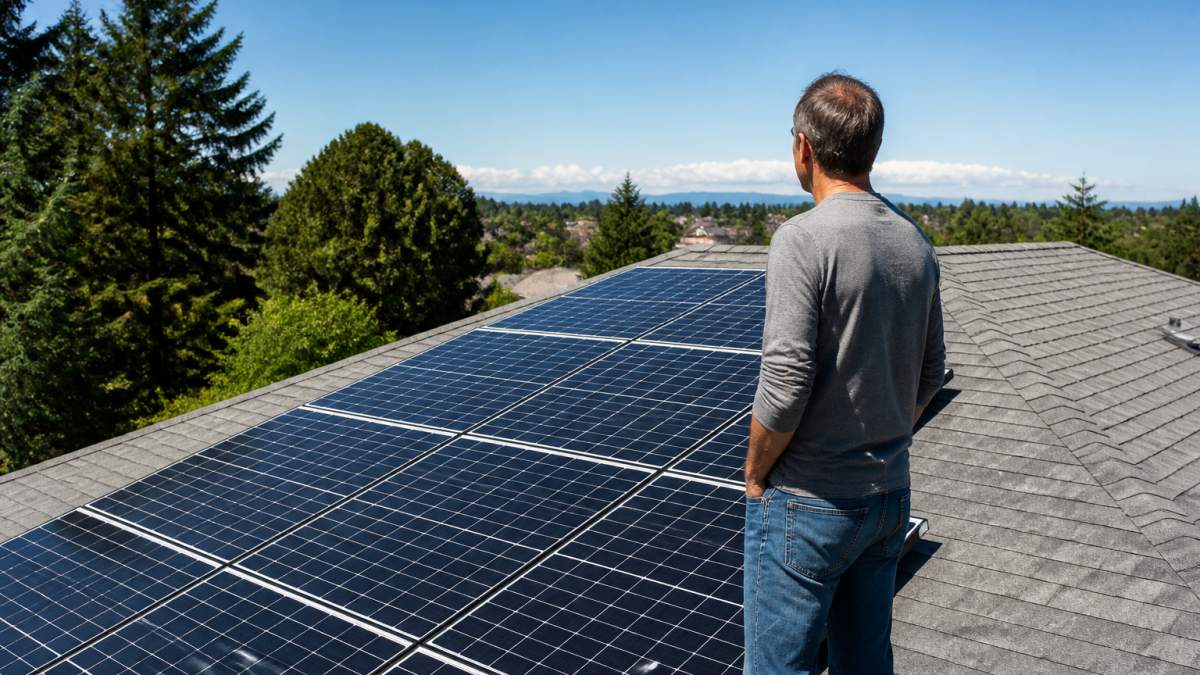
The choice between these options determines your long-term costs, tax benefits, and flexibility. At Go Solar DMV, we help homeowners navigate these distinctions using our AI Solar Advisor and detailed quote comparison audits. Many homeowners assume all $0-down options are identical. They're not. The difference between a lease and a loan can mean thousands of dollars over 25 years.
Solar Lease vs. Solar Loan: Which Financing Model Works for You
A solar lease is a fixed monthly payment for the use of a solar system installed on your roof. You pay a set amount each month regardless of how much electricity your system produces. The solar company owns, maintains, and repairs the system for the entire 20-25 year contract term.
A solar loan, by contrast, gives you ownership. You borrow money to purchase the system and pay back the loan with interest over 15-20 years. You own the equipment, claim tax credits, and keep all electricity production benefits.
The lease model works best if you want predictability and zero maintenance responsibility. Your monthly payment stays the same. The solar company handles repairs, replacements, and performance monitoring. You cannot claim federal tax credits or state incentives because you don't own the system.
Solar loans appeal to homeowners who want to maximize long-term savings and build equity in an asset. You claim the 30% federal investment tax credit, which reduces your taxable income and lowers your effective cost. You keep all energy production benefits and can sell excess power back to the grid through net metering programs that pay 1:1 rates in Maryland and Virginia.
The tradeoff is responsibility. If the system fails, you arrange repairs. If your roof needs replacement, you coordinate that work around the solar panels. Most homeowners find this manageable, especially with a strong warranty.
Solar Power Purchase Agreements (PPAs): How They Work and What to Expect
A power purchase agreement is a contract where you agree to buy electricity from a solar system installed on your property at a rate locked in for 20-25 years. Unlike a lease, you pay only for electricity produced, not a fixed monthly amount.
PPAs function similarly to leases in structure: a third party owns and maintains the system. The difference is payment. With a lease, you pay per month. With a PPA, you pay per kilowatt-hour (kWh) of electricity your system generates.
PPAs appeal to homeowners with variable electricity usage or homes where production fluctuates seasonally. In months when your system produces less (winter months with shorter days), your bill is lower. In high-production months, you pay more. This aligns your payment with actual electricity generation.
The PPA rate typically starts lower than your current utility rate and includes an escalator clause, usually 2-3% annual increases. This protects the solar company against inflation while giving you certainty about how much your rate will rise each year.
PPAs work well in markets with strong net metering policies, like Maryland and Virginia, where excess production can offset future consumption or earn credits. Go Solar DMV's Master ZIP code index tracks which PPA structures work best in each service area based on local utility rates and solar incentives.
Solar Loan Terms and Monthly Payments: Breaking Down Your Costs
Solar loans typically span 15-20 years with fixed interest rates ranging from 3-8% depending on your credit profile and lender. Your monthly payment covers principal, interest, and sometimes system monitoring fees.
The real cost of a solar loan isn't just the monthly payment, it's the total interest paid over the loan term. A $20,000 system at 6% interest over 20 years costs significantly more than the same system at 4% interest. This is why credit quality matters. Homeowners with credit scores above 750 typically qualify for rates 1-2% lower than those with scores between 650-700.
Most solar loans include a performance guarantee. If your system underperforms the estimated production, the solar company credits the difference toward your loan balance. This protects you if shading increases, panels degrade faster than expected, or the installer made errors in the initial assessment.
Many homeowners overlook loan origination fees, which typically range from 1-3% of the loan amount. A $25,000 system with a 2% origination fee adds $500 to your financed amount, increasing total interest paid over the loan term.
The advantage of a solar loan is the federal investment tax credit. You claim 30% of the system cost as a tax credit in the year of installation. On a $25,000 system, that's a $7,500 credit that reduces your federal income tax dollar-for-dollar. This effectively cuts your net cost to $17,500 before any state incentives.
Hidden Fees in Solar Contracts: What to Watch For
Solar contracts often contain fees that aren't obvious in marketing materials. Understanding these prevents surprise costs and protects your long-term savings.
Monitoring fees appear in many solar loan and PPA contracts. These typically range from $10-30 monthly and cover system performance tracking, alerts for underperformance, and customer support. Some contracts bundle this into the payment; others list it separately.
Interconnection and permitting fees are sometimes passed to the homeowner rather than absorbed by the solar company. These cover the cost of connecting your system to the grid and obtaining local permits. Legitimate fees range from $500-2,000 depending on local requirements. Anything above this warrants clarification.
Early termination or buyout penalties appear in lease and PPA contracts. If you want to exit the agreement early, because you're selling your home or switching providers, you may owe a termination fee.
Roof repair or replacement fees sometimes fall on the homeowner if roof work is needed during the contract term. Some contracts specify that the solar company handles this; others require you to pay. This can run $2,000-8,000 depending on roof size and condition.
Escalator clauses in PPAs and some leases increase your payment annually. A 2% escalator on a $150 monthly PPA payment means your bill rises $3 per month each year. Over 25 years, that compounds significantly. Always confirm the escalator percentage in writing.
Go Solar DMV's quote comparison audit specifically flags these fees by comparing them across multiple offers. Most homeowners don't catch these until after signing, which limits negotiation options.
Eligibility Requirements and Credit Considerations
Not all homeowners qualify for every financing option. Credit score, income, home ownership status, and roof condition all factor into eligibility.
Solar loans typically require a credit score of 650 or higher. Scores above 750 unlock the best interest rates. If your score is between 650-700, expect rates 1-2% higher than prime rates.
Solar leases and PPAs are more flexible with credit requirements because the solar company retains system ownership and can repossess it if payments lapse. Many providers approve customers with credit scores as low as 600. However, approval still depends on your payment history and debt-to-income ratio.
Home ownership is a hard requirement for all three options. Renters cannot install rooftop solar without landlord permission, and most landlords won't allow 25-year system installations. Community solar programs exist for renters in some areas, but that's a different model entirely.
Roof condition affects approval. If your roof is nearing the end of its serviceable life (typically 20-25 years for asphalt shingles), solar companies may require roof replacement before installation. This adds $8,000-15,000 upfront, defeating the $0-down advantage.
Debt-to-income ratio matters for loan approval. Most lenders want your total monthly debt payments, including the solar loan, to stay below 43% of gross monthly income.
Property tax assessment is a consideration in some states. A few jurisdictions reassess property taxes when you install solar, potentially increasing your annual tax bill. Maryland and Virginia generally exempt solar systems from property tax increases, but confirming this with your local assessor is wise.
Making Your Decision: A Step-by-Step Process
Start by determining your primary goal: maximum long-term savings, monthly payment predictability, or minimal maintenance responsibility.
Step 1: Assess your roof and timeline. Use Google Project Sunroof or similar tools to estimate your roof's solar potential and how long it will remain in good condition.
Step 2: Check your credit and debt profile. Pull your credit report and calculate your debt-to-income ratio. This determines which financing options are available and what interest rates you'll qualify for.
Step 3: Research local incentives. Federal tax credits apply to all three models if you own the system (loans), but state and local incentives vary.
Step 4: Request quotes from multiple providers. Get at least three detailed quotes specifying the system size, estimated annual production, financing terms, all fees, escalator clauses, and buyout options.
Step 5: Calculate total 25-year cost. Don't compare monthly payments alone. Build a spreadsheet showing total out-of-pocket cost over the full contract term, accounting for escalators, tax credits (if applicable), and estimated electricity bill savings.
Step 6: Review contract details carefully. Before signing, confirm roof repair responsibilities, maintenance obligations, early termination penalties, system buyout options, and what happens if you sell your home. Ask the solar company to explain any clause you don't fully understand.
| Financing Option | Best For | Monthly Cost Predictability | Long-Term Savings | Maintenance Burden | Tax Credit Eligible |
|---|---|---|---|---|---|
| Solar Lease | Simplicity seekers | High (fixed) | Moderate | None (provider) | No |
| Solar PPA | Variable usage homes | Medium (tied to production) | Moderate-High | None (provider) | No |
| Solar Loan | Ownership seekers | High (fixed) | Highest | Yes (you own it) | Yes (30% credit) |
Getting solar without upfront investment is achievable, but the path depends on your financial situation, roof condition, and long-term plans. Homeowners often choose the first financing option they encounter rather than comparing all three.
Frequently Asked Questions
Are $0-down solar offers really free?
$0-down solar means no upfront installation costs, but you'll pay through monthly lease payments, loan payments, or PPA rates over 20-25 years. You're financing the system rather than buying it outright. The system itself is installed and maintained at no cost to you, but you're paying for the electricity it produces or the loan that covers it. Always review the contract to understand your total long-term obligation.
What's the difference between a solar lease and a power purchase agreement?
A solar lease is a fixed monthly payment for the system itself, regardless of how much electricity it produces. A PPA ties your payments to actual electricity output, you pay per kilowatt-hour generated. Leases offer predictable costs; PPAs reward high-production systems. PPAs often provide better savings if your roof gets strong sun exposure. Both keep you from owning the system, and both typically last 20-25 years.
What happens if I move or sell my house with a solar lease or PPA?
Most solar leases and PPAs are tied to the property, not the homeowner. If you sell, the new owner can assume the agreement, or you may need to pay a transfer fee or buyout amount. Some contracts allow early termination, but this often costs thousands. Before signing, confirm the contract's portability terms and what happens at sale. This is a critical question to ask your solar provider before committing.
What hidden fees should I look for in solar contracts?
Watch for monitoring fees, maintenance charges, early termination penalties, transfer fees if you sell, and annual escalator clauses that raise payments yearly. Some contracts include system replacement fees or roof repair costs. Request an itemized breakdown of all costs over the full contract term. Compare total 25-year cost across providers, not just monthly payments. Ask specifically what happens if the system underperforms or needs repairs.