How to Solar Power Your Home: A Step-by-Step Guide
Last Updated: November 13, 2026
Quick Summary
To solar power your home, install solar panels on your roof that convert sunlight into electricity through an inverter, with excess power flowing to the grid for credit. Most homes stay grid-connected, and batteries are optional for backup. Start by checking roof sun exposure, condition, and electrical panel capacity before getting quotes.
- Solar supplied 8.2% of U.S. electricity in the 12 months through August 2025.
- Panels produce DC power, and an inverter converts it to AC for home appliances.
- Check roof direction, shading, condition, and electrical panel capacity before buying.
- Size the system from 12 months of kWh use, adding 10% to 20% for planned electrification.
- Get a line-item quote separating equipment, labor, and soft costs to compare bids.
Table of Contents
- How Residential Solar Power Works
- Checking Whether Your Home Is Suitable for Solar
- Estimating Your Electricity Use and Sizing a Solar Panel System
- Solar Power Your Home Cost: Components Versus Labor
- Choosing a Home Solar System Kit or Professional Installation
- Battery Storage, Backup Power and Grid-Tied Versus Hybrid Systems
- Finding Solar Panel Grants and Incentives, Then Booking Your Site Assessment
- Frequently Asked Questions
How Residential Solar Power Works
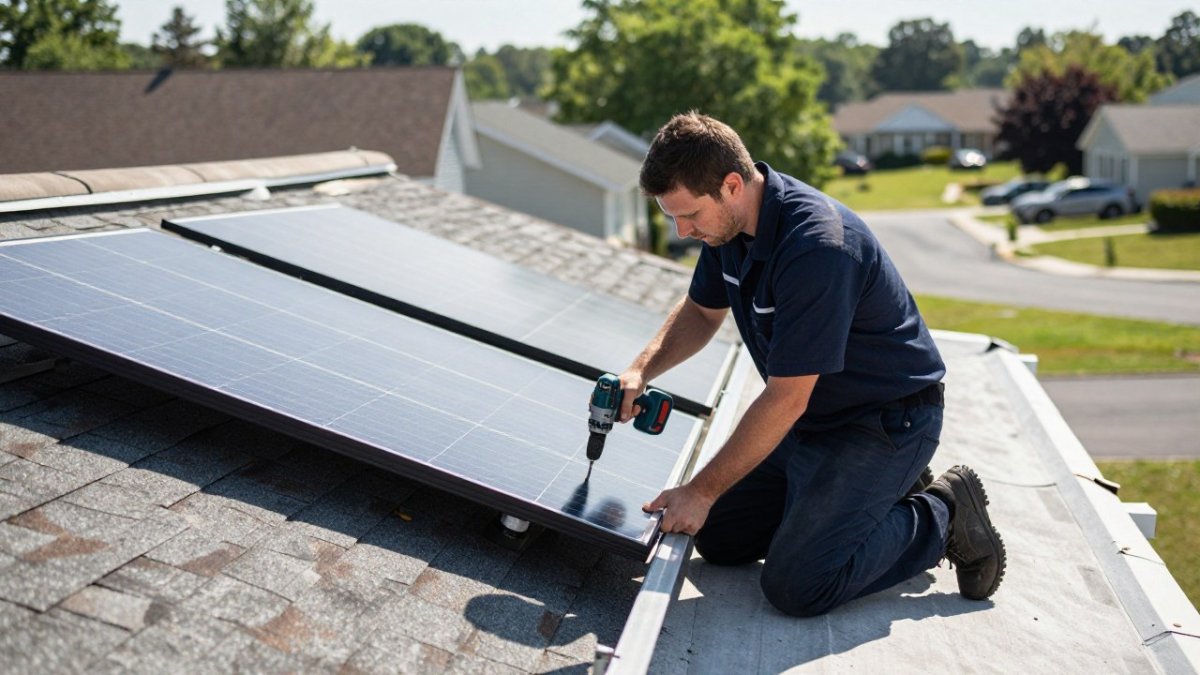
To solar power your home, you install solar panels on your roof that turn sunlight into electricity your house can use. Solar supplied 8.2% of U.S. electricity in the 12 months through August 2025, up from 6.9% in 2024 (U.S. Department of Energy, Quarterly Solar Industry Update). That share keeps growing as more homeowners make the switch.
Here is the basic path power takes. Sunlight hits the panels and creates direct current (DC) electricity. An inverter converts that DC power into alternating current (AC), which is what your appliances use. Any extra power flows to the grid, and your utility credits you for it.
Most homes stay connected to the grid, so you never run out of power at night. Battery storage is optional, and we cover it later in this guide.
Checking Whether Your Home Is Suitable for Solar
Before you spend anything, confirm your roof can actually produce enough power. Start with three questions: Does your roof get direct sun? Is it in good repair? Can your electrical panel handle the added load?
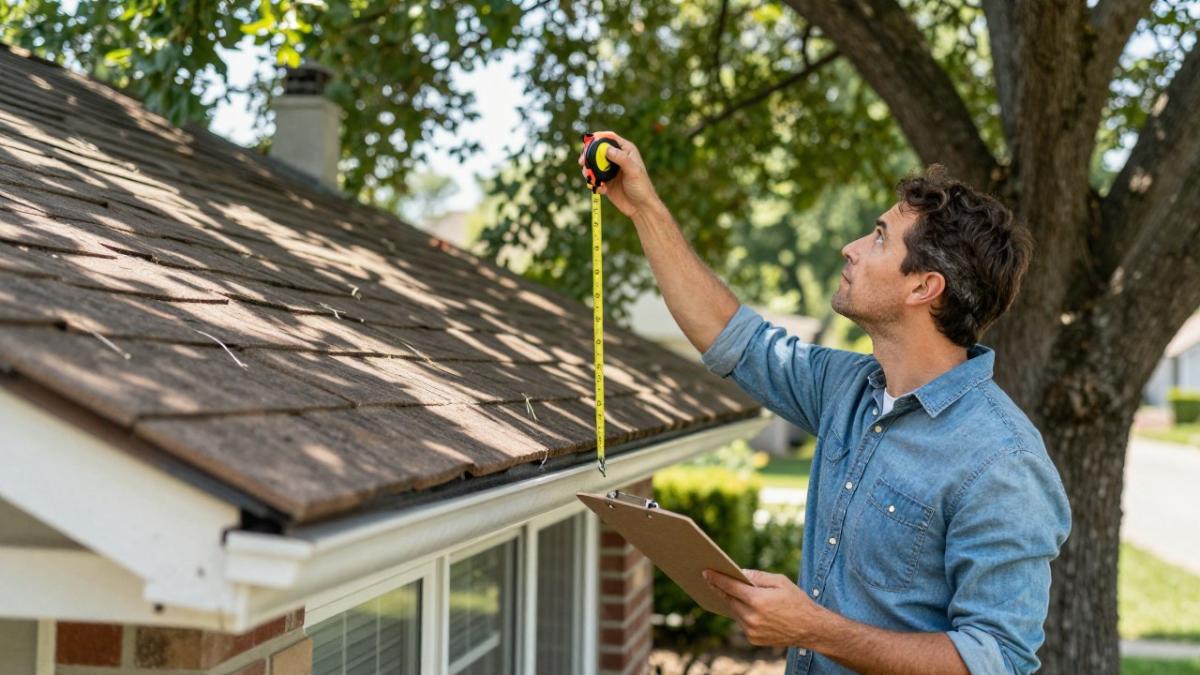
Go Solar DMV offers a Solar Roof Score tool, which lets you check your roof's annual sun hours and usable roof area for your address. It is a good first step before you talk to anyone.
Roof Condition, Orientation and Shading
Panels work best on a roof that faces south or west and gets strong sun for most of the day. Shade from trees or nearby buildings cuts output, sometimes sharply, even when only part of a panel is covered.
Watch out: a roof that needs repair should be fixed before panels go up. Pulling panels off later to replace shingles costs extra.
Structural Suitability and Electrical Panel Capacity
A solar array is heavy, so the roof frame has to support it. Ask an installer to check the rafters and the age of the roof covering.
Your main electrical panel also needs room for the system's breaker. Older panels may need an upgrade first. Google Project Sunroof's 3D roof modeling can show sun exposure across each roof face before you commit.
Estimating Your Electricity Use and Sizing a Solar Panel System
Sizing is where most homeowners guess and most installers quietly pad. A transparent worksheet fixes both problems. The goal is to match panel capacity to your actual annual consumption, then size the inverter and any battery to the way you use power.
Step 1: Pull 12 months of kWh consumption
Log in to your utility account and download the last 12 months of usage in kilowatt-hours (kWh). Add the monthly figures to get annual consumption. If you have a year of unusual events, a new heat pump, an electric vehicle, a newborn, adjust upward rather than sizing to the anomaly. A common pattern is to add 10% to 20% headroom for electrification you plan within five years.
Step 2: Find your peak sun hours
Peak sun hours are not the same as daylight hours. Use the Residential Rooftop & Ground Solar Systems calculator to model your own home's savings and ROI. They represent the equivalent number of hours per day at 1,000 watts per square meter. Most of the contiguous U.S. falls between about 4.0 and 5.5 peak sun hours per day on an annual average, with the Southwest higher and the Northeast and Pacific Northwest lower. Your installer's site assessment or a tool like Google Project Sunroof will give you a location-specific figure.
Step 3: Apply a system loss factor
No array produces its rated output. Inverter conversion, wiring, soiling, temperature derating, and mismatch between panels typically consume 14% to 25% of nameplate output.
Step 4: Calculate panel capacity
The worksheet:
- Annual kWh needed ÷ (peak sun hours per day × 365 × derate factor) = system size in kW
- System size in kW × 1,000 ÷ panel wattage = number of panels
Worked example: a household using 10,800 kWh per year in a location with 4.5 peak sun hours and a 0.80 derate needs 10,800 ÷ (4.5 × 365 × 0.80) ≈ 8.2 kW. At 400 watts per panel, that is about 21 panels. Round up, not down, undersizing leaves you buying grid power at retail while overpaying for the array.
Step 5: Size the inverter
Inverters are rated in kW AC and are often intentionally smaller than the array (a DC-to-AC ratio around 1.1 to 1.3 is common) because panels rarely hit nameplate output simultaneously. A 8.2 kW array paired with a 7.6 kW inverter is a typical pairing. String inverters are cheapest; microinverters and DC optimizers cost more but handle shading and panel-level monitoring better.
Step 6: Size battery capacity if you are adding storage
Battery capacity is measured in kWh of usable storage. Size to your critical-load backup needs, refrigerator, well pump, medical equipment, a few circuits, not to your whole-house consumption, unless you are prepared for a very large battery bank.
Watch out: sizing to last year's usage without accounting for a planned EV or heat pump is the single most common reason a new array underproduces. Build the future load in before you sign.
Use a Residential Solar Panel System Cost Breakdown guide to see how each additional kW affects the price, and confirm your final numbers against your installer's production estimate, the two should land within about 10% of each other.
Solar Power Your Home Cost: Components Versus Labor
Cost is the question every homeowner asks first, and the honest answer has two halves: what the equipment costs and what the soft costs, labor, permits, interconnection, and design, add on top. Installed residential solar pricing depends on market, roof complexity, equipment tier, and incentives. For current pricing for your property, request a quote from Go Solar DMV.
What the equipment costs
Equipment is typically 40% to 55% of the installed price. Rough benchmarks for planning:
- Panels: roughly $0.30 to $0.60 per watt for the modules themselves, depending on efficiency tier and brand
- Inverter: a string inverter runs roughly $1,000 to $2,500 for a residential system; microinverters cost more per panel but simplify wiring and shading
- Racking and mounting: roughly $0.15 to $0.30 per watt
- Battery storage: commonly $8,000 to $15,000 per unit installed, before incentives, depending on usable capacity and whether the installation is retrofit or new
What the soft costs add
Soft costs, labor, permits, inspection, interconnection fees, design, and sales, are the larger share of the installed price in most U.S. markets and the part homeowners most often underestimate. Utility interconnection fees are separate and also vary.
How incentives change the net price
State and local programs vary widely, some offer rebates, some offer property tax exemptions, and some offer both. Your utility may also offer a production-based incentive or net metering that affects lifetime savings rather than upfront price. The Washington, D.C. Solar Incentives, SRECs & Tax Credits guide covers the local programs in detail.
Watch out: quotes that advertise a single "price per watt" without separating equipment, labor, and soft costs make it hard to compare bids. Ask each installer for a line-item breakdown so you can see whether you are paying for premium panels or premium overhead.
For current pricing in your area, contact Go Solar DMV for a quote. The Solar Panel Installation in Washington, D.C. page also lets you compare local installers side by side.
Choosing a Home Solar System Kit or Professional Installation
A DIY kit can look cheaper, but home solar involves high-voltage wiring, roof work, and utility approvals. Most homeowners should use a licensed installer.
A professional installation usually includes the design, permits, inspection, and utility interconnection. Those steps are what keep the system safe and legal.
- Kit: Lower equipment cost, but you handle permits and wiring
- Professional installation: Higher upfront cost, with design, permits, and warranty support included
Watch out: work on the main electrical panel is dangerous without training. Leave it to a licensed electrician.
Battery Storage, Backup Power and Grid-Tied Versus Hybrid Systems
A grid-tied system sends excess power to the grid and pulls from it at night. It is the most common setup and usually the least expensive.
A hybrid system adds battery storage. The battery stores extra daytime power for use after dark or during an outage. Batteries add cost, so weigh them against your outage risk and your utility's export rules.
Off-grid systems cut the utility connection entirely. They need large battery banks and are rarely practical for homes already connected to the grid.
| System Type | Connected to Grid | Battery Storage | Best For |
|---|---|---|---|
| Grid-tied | Yes | No | Lower upfront cost |
| Hybrid | Yes | Yes | Outage backup |
| Off-grid | No | Yes | Homes with no grid access |
Finding Solar Panel Grants and Incentives, Then Booking Your Site Assessment
Check federal, state, and local incentives before you sign anything. The Washington, D.C. Solar Incentives, SRECs & Tax Credits guide explains the local programs in detail.
Once you know your options, book a site assessment. A good installer will check your roof, electrical panel, and usage data. You can also compare local installers on the Solar Panel Installation in Washington, D.C. page to request a free quote.
Solar can cut your electric bills for decades. Start with a roof check, then move to a professional assessment. Go Solar DMV can help you through each step, from your first site review to a final installation quote.
Frequently Asked Questions
How much solar power is needed to run a house?
The amount depends on your annual electricity use, which you can find on your utility bills in kilowatt-hours (kWh). Divide your yearly consumption by the expected output of one panel in your location, which depends on peak sun hours and roof orientation, to estimate how many panels you need. Many homes in the Virginia, Maryland and Washington, D.C. area combine a few kilowatts of capacity with net metering to cover most of their usage. A site assessment will confirm the exact figure for your roof.
How much does solar power your home cost?
Solar power your home cost varies with system size, equipment, roof complexity, labor, permits and whether you buy, lease or finance. Equipment such as panels, inverters and mounting hardware makes up a significant share of the price, while labor, electrical work and permitting account for the rest. Ask each installer for an itemized quote so you can compare components and labor directly. Go Solar DMV can provide current pricing for your property through a site-specific quote.
Can solar panels power a home during a grid outage?
A standard grid-tied system shuts off during an outage for safety reasons, so it will not power your home on its own. Adding battery storage or choosing a hybrid system with a backup-capable inverter allows the home to run on stored solar energy during a blackout. The amount of backup power depends on battery capacity and how much electricity you use. Confirm these limits with your installer before you rely on the system for critical loads.
What solar panels for home government grant options are available?
Federal, state and local incentives can reduce the cost of a home solar system, and their availability changes over time. Check the Database of State Incentives for Renewables and Efficiency (DSIRE) and your state energy office for current programs in Virginia, Maryland and Washington, D.C. Many incentives depend on the system meeting technical requirements and on timely permit and interconnection approval. Ask your installer which incentives apply to your property before you sign a contract.
