Solar Panel Performance in Cloudy Weather Explained
Last Updated: November 8, 2026
Quick Summary
Solar panels still produce electricity on cloudy weather, but output drops, sometimes sharply, depending on how thick and long-lasting the cloud cover is. Systems rarely shut off completely, so homeowners should plan for the lower end of the range rather than peak output.
- Output falls during cloudy weather but does not stop entirely.
- Dense, low overcast cuts output the most, while thin, high clouds cut it less.
- Estimate cloudy-day output from your own system's monitoring data where possible.
- Panels do not produce power at night, and shade can reduce output more than clouds.
- Compare your cloudy-day energy against your own clear-day baseline for the same month.
Table of Contents
- Do Solar Panels Still Work on Cloudy Days?
- How Clouds Reduce Sunlight Reaching Your Panels
- Solar Panel Output on Cloudy Days: What to Expect
- Best Solar Panels for Cloudy Days: Does Panel Type Matter?
- Rain, Cool Temperatures, and Solar Panel Performance
- Shade, Night Operation, and Other Common Myths
- Estimating and Monitoring Your Cloudy-Day Production
- Frequently Asked Questions
Solar panels still produce electricity on cloudy days, but they produce less. Clouds block part of the direct sunlight that drives panel output, and the drop can be large or small depending on how thick the cloud cover is and how long it lasts. For homeowners in Virginia, Maryland, and Washington, D.C., where overcast days are common for much of the year, knowing what to expect matters for planning. Experimental assessment of the performance of PV panels in clear and cloudy weather found electrical efficiency of 13.574% in clear weather and 12.12% in cloudy weather at noon. At Go Solar DMV, we explain these patterns so homeowners can set realistic expectations before they go solar.
Do Solar Panels Still Work on Cloudy Days?
Yes, solar panels keep working when the sky is overcast. Solar Energy Industries Association on solar panels and cloud cover explains that output falls during cloudy periods but does not stop.
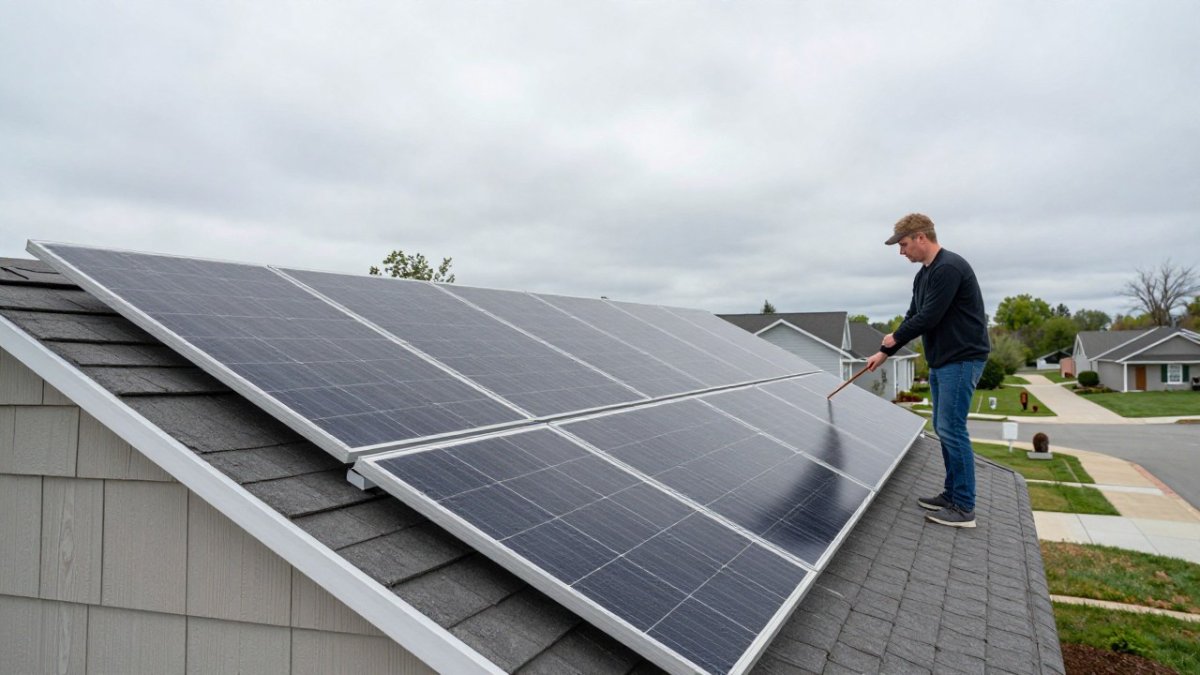
A homeowner's rooftop array under a gray sky still generates usable power. The question is not whether it works, but how much it produces compared with a sunny day.
- Panels respond to visible light, not just direct sun.
- Light that passes through or bounces off clouds still reaches the cells.
- Output drops, but a system rarely shuts off completely.
How Clouds Reduce Sunlight Reaching Your Panels
Clouds scatter and absorb sunlight before it reaches the panel surface. Thicker and longer-lasting clouds block more light, which lowers output. Research summarized in A Review of Solar Panel Efficiency in Different Weather found that cloudy conditions in Europe and North America can cut solar efficiency by 20% to 60%, depending on cloud thickness and duration.
Those figures describe different measures and conditions, so no single percentage applies to every roof. For a broader look at how output is measured, see our guide on how to calculate solar panel efficiency and output.
Solar Panel Output on Cloudy Days: What to Expect
Expect lower output on overcast days, and plan for the low end of the range rather than the peak. Estimates vary widely depending on cloud cover, measurement method, and location.
Those broad ranges are a starting point, not an answer. A more useful approach is to estimate output from your own system using three inputs: system size, local weather, and your own historical production.
A Simple Method for Estimating Your Own Output
- Start with your system's rated size in kilowatts (kW). This is the DC or AC nameplate figure on your contract or monitoring app.
- Apply a clear-sky production factor. Use the production estimate your installer provides for your roof, which is more reliable than a general planning figure.
- Apply a cloud-cover adjustment. Estimate how much your system produces on overcast days relative to clear days, using your own monitoring data where available.
- Compare against your own history. Once you have a month of monitoring data, replace the generic factors with your system's actual cloudy-day production.
Your own clear-day and overcast-day production figures are the most reliable basis for planning.
Watch out: cloud-cover adjustments are not linear with the percentage of sky covered, and a day labeled "cloudy" in a weather app can include long sunny breaks, so use these bands to set expectations rather than to predict a specific day.
Light Cloud Cover Versus Heavy Overcast
Light cloud cover has a smaller effect than heavy overcast. High, thin clouds let more light through, so output may drop only slightly. Dense, low clouds cut output much more.
- Thin, high clouds (cirrus): Output typically stays closer to clear-sky levels than under dense cloud.
- Broken cumulus: Output can swing up and down as clouds move across the sun.
- Dense, low overcast (stratus): Output drops the most, especially when clouds stay in place for hours.
Cloud thickness and movement matter as much as the weather label. A fast-moving broken-cloud day can deliver more total energy than a flat gray day, even though the gray day looks brighter to the eye.
Cloud Lensing and Temporary Output Spikes
Cloud edges can occasionally focus sunlight onto panels, briefly boosting output. These spikes are short and unpredictable, so they should not be counted on in long-term planning.
For a broader look at how output is measured, see our guide on how to calculate solar panel efficiency and output. Readers planning annual returns should use realistic cloudy-day figures; our solar panel ROI calculation guide for 2026 walks through payback periods and annual savings with those numbers in mind.
Best Solar Panels for Cloudy Days: Does Panel Type Matter?
Panel type matters less than most buyers expect. Cloudy-day output depends mainly on the weather and the system's size, placement, and wiring. Compare panels on rated efficiency, warranty terms, and how well they fit your roof, then judge cloudy-day performance by real production data rather than marketing claims.
Rain, Cool Temperatures, and Solar Panel Performance
Rain and cool air do not hurt panels the way many people assume. Rain usually comes with clouds, so the output loss comes from the clouds, not the water.
Cool temperatures can help, since panels generally run more efficiently when cooler. The sunlight itself is the bigger limit.
- Rain is usually a sign of heavy cloud, which is the real cause of lower output.
- Cool, clear weather often gives better efficiency than hot weather.
- Snow on panels blocks output until it slides off or melts.
Shade, Night Operation, and Other Common Myths
Solar panels do not produce power at night, and shade can significantly reduce output. A tree that blocks the afternoon sun can cut production sharply, even on a sunny day. Cloud cover and shade are separate problems, and each needs its own fix.
Many homeowners ask whether a west-facing roof with afternoon tree shade can still work. Shade is a site-specific question, so have a professional check your roof before deciding.
- Myth: Panels stop working when it is cloudy. Fact: They keep producing, at reduced levels.
- Myth: Rain damages panels. Fact: Panels are built to handle rain.
- Myth: Shade matters less than clouds. Fact: Shade can have a large effect on output, often more than clouds.
Estimating and Monitoring Your Cloudy-Day Production
Track your system's output over several overcast days and compare it with sunny days to see your real pattern. Most monitoring apps show daily production, which makes this simple. Use the energy monitor to follow output day to day, and check your performance testing guide if your numbers look low.
To compare like with like, separate power from energy. Power (in kW) is the instantaneous rate at a moment; energy (in kWh) is the total over a day. A cloudy day lowers peak power and total energy, but the shape of the daily curve matters too. Compare your cloudy-day energy against your own clear-day baseline for the same month, not against a neighbor's system or a national average.
A Troubleshooting Checklist for Unexpectedly Low Output
If a cloudy day produces far less than the weather explains, work through these in order before assuming the system is broken:
- Check the weather, not just the label. Confirm actual cloud cover and whether the day included sun breaks. A "cloudy" forecast with afternoon clearing should not be compared to a flat overcast day.
- Look for new shade. A growing tree, a new chimney, or a satellite dish can shade a string. Shade hurts output far more than most clouds do.
- Inspect for dirt and debris. Dust, pollen, bird droppings, and leaf litter cut output gradually and are easy to miss. A rinse can restore a few percent.
- Check snow or standing water. Snow blocks output until it slides off or melts; pooled water or debris at the array edge can indicate a mounting or drainage issue.
- Review inverter alerts and status lights. Most inverters log faults and grid events. A derated or offline inverter will show up here first.
- Compare strings, not just the total. If your monitoring shows per-string data, a single underperforming string points to shade, soiling, or a wiring or connector fault rather than weather.
- Confirm monitoring is current. A stale data feed or a communication outage can look like a production drop when the system is fine.
Watch out: a sudden drop that persists across sunny days is a fault signal, not a weather effect, and should be referred to your installer rather than diagnosed from the app alone.
Using Your Data to Set Expectations
After a few weeks, most systems show a recognizable pattern: clear days near the top of the range, broken-cloud days in the middle, and dense overcast days at the bottom. Save a screenshot of a typical clear day and a typical overcast day for the same month so you have a personal baseline. When a cloudy day falls well below that baseline, the checklist above tells you where to look first.
Homeowners who want help comparing options can start with a free consultation from Go Solar DMV. Go Solar DMV's $0-down solar lease keeps the system installed and maintained at no cost, so you can focus on your energy costs rather than repairs. Get in touch to see what your roof can realistically produce.
Tracking your own system is the most reliable way to see how much it produces on overcast days. A few numbers from the article can help you compare days.
| Symptom | Likely cause | Fix |
|---|---|---|
| Output far below cloudy-day baseline | New shade from trees or structures | Trim vegetation or relocate obstruction |
| Gradual output decline | Dirt, pollen, bird droppings, or leaf litter | Rinse the array to restore output |
| Low output on sunny days | Snow or standing water on panels | Wait for snow to slide off or melt |
| One string underperforms | Shade, soiling, or wiring or connector fault | Check per-string data and call your installer |
| Drop persists across sunny days | Inverter fault or derated inverter | Review inverter alerts and contact your installer |
| Data looks stale or missing | Monitoring communication outage | Confirm the monitoring feed is current |
Frequently Asked Questions
How effective are solar panels when it is cloudy?
Solar panels still produce electricity on cloudy days, but output drops. Cloudy conditions reduce output, with the size of the reduction depending on cloud thickness and how long the clouds last. Panels also capture diffuse and reflected light, so they rarely drop to zero while daylight persists.
Will my solar panels work on a cloudy day?
Yes. Solar panels work on cloudy days because they convert diffuse sunlight, not only direct sun. Panels keep working when light is reflected or partly blocked by clouds. Expect lower output than on a clear day, with the exact drop depending on how thick the clouds are and how much light gets through. Monitoring your system's daily production history is the most reliable way to see your own cloudy-day numbers.
Are some solar panels better for cloudy days?
Panel type affects output in low light, but the difference is usually modest compared with system design, orientation, and shading. Choosing an installer who models your roof and compares quotes side by side can matter more than picking a specific brand for cloudy weather.
Do solar panels work in the shade?
Partial shade reduces output more than the shaded area suggests, because many systems link panels in series and the weakest panel limits the string. Heavy shade from trees or nearby buildings can cut production significantly, especially in the afternoon. Before installing, a shade analysis of your roof can show how much output a west-facing array may lose to afternoon shade.
