Solar Panel System Performance Testing: What to Measure
Last Updated: November 6, 2026
Quick Summary
Solar panel system performance testing measures how much power your panels actually produce against what they were rated to produce, under conditions you can document and repeat. A proper test runs in a fixed order: safety check, isolation, measurement, comparison to design, then a written report. Compare measured output to expected output for the same conditions, not to the nameplate.
- Standard Test Conditions rate panels at 1,000 watts per square meter, 25°C cell temperature, and a standard air mass.
- A multimeter gives open-circuit voltage and short-circuit current, not true wattage at the maximum power point.
- Performance ratio divides delivered energy by expected energy; a worked example gives 44 kWh divided by 55 kWh, or 0.80.
- Compare performance ratio to the same month in prior years before calling a fault, since seasonal dips repeat.
- Call a licensed professional whenever testing requires opening a disconnect or probing live DC conductors.
Table of Contents
- What Solar Panel System Performance Testing Actually Measures
- The Solar PV Testing Procedure From Safety Check to Signed Report
- How to Test Solar Panel Wattage With a Multimeter
- How to Test a Solar Panel Without a Multimeter
- String Faults, Inverter Checks, and Reading Performance Ratio
- What Solar Panel System Performance Testing Costs
- When to Call a Licensed Solar Professional
- Get a Free Performance Review Before You Sign Anything
- Frequently Asked Questions
What Solar Panel System Performance Testing Actually Measures
Solar panel system performance testing measures how much power your panels actually produce against what they were rated to produce, under conditions you can document and repeat. In 2025, solar generated 6.7% of U.S. electricity, according to the University of Michigan Center for Sustainable Systems, which means millions of homeowners now depend on systems they cannot easily check themselves.
This Go Solar DMV guide fills that gap: a performance test is a set of measurements, taken safely, written down, and compared to a design specification.
A single multimeter reading is not a verdict, one sunny-afternoon number tells you almost nothing about panel health over a year.
Below, we break down what each measurement means, how to take it safely, and when to hand the job to a licensed pro.
Standard Test Conditions and Rated Wattage
Every panel carries a wattage rating, but that rating comes with fine print. Standard Test Conditions (STC) are the lab settings used to rate panels: 1,000 watts of sunlight per square meter, a cell temperature of 25°C, and a standard air mass.
Real roofs rarely match a lab. Cell temperatures climb well past 25°C in direct sun, and that heat alone pulls output down.
Why Field Readings Never Match the Nameplate
A 400-watt panel will almost never show 400 watts on your roof, normal, not a defect.
Field readings fall short for predictable reasons:
- Heat: panels lose output as cells get hot
- Irradiance: haze, clouds, and low sun cut available sunlight
- Age: one case study from the University of Kentucky reported average panel generation capability declining about 1.04% per year from material degradation
The fix is to compare measured output to expected output for the same conditions, not to the sticker. For the deeper explanation of how solar panel efficiency is calculated and what affects real-world output versus rated wattage, see our full article.
The Solar PV Testing Procedure From Safety Check to Signed Report
A proper solar PV testing procedure runs in a fixed order: safety check, isolation, measurement, comparison to design, then a written report.
A federal report on 75 photovoltaic systems at federal sites shows why documentation matters. Without recorded baselines, you cannot tell a slow decline from a sudden fault.
Here is the sequence a qualified technician follows:
- Visual and safety inspection. Check for damaged conduit, loose mounts, and water intrusion.
- Isolation. Shut down the inverter and open the DC disconnect before touching conductors.
- Voltage and current checks. Measure open-circuit voltage (Voc) and short-circuit current against the design spec.
- String and inverter checks. Confirm each string matches its siblings and the inverter reads correctly.
- Performance ratio calculation. Compare measured output to expected output for the recorded irradiance.
- Signed report. Log every reading, the weather, the time, and the instruments used.
That last step is the one homeowners forget to demand. A verbal "looks fine" is not a test result.
Isolation, Voltage, and Current Checks
Open-circuit voltage (Voc) is the voltage a panel or string produces with no load connected. Short-circuit current is the current that flows when the output leads are connected together through a meter.
Both readings catch different faults: low Voc often means a failed bypass diode or broken connection, while low current under load often means shading or soiling.
Do not test a live array with the inverter running. Isolate first, every time.
A qualified technician follows a fixed sequence, and each step produces a record you can compare later.
| Step | What to do |
|---|---|
| 1 | Visual and safety inspection for damaged conduit, loose mounts, water intrusion |
| 2 | Isolation: shut down inverter and open DC disconnect |
| 3 | Measure Voc and short-circuit current against design spec |
| 4 | Confirm each string matches its siblings and inverter reads correctly |
| 5 | Calculate performance ratio against recorded irradiance |
| 6 | Log readings, weather, time, instruments in a signed report |
How to Test Solar Panel Wattage With a Multimeter
You can measure a single panel's open-circuit voltage and short-circuit current with a multimeter, but not true wattage directly.
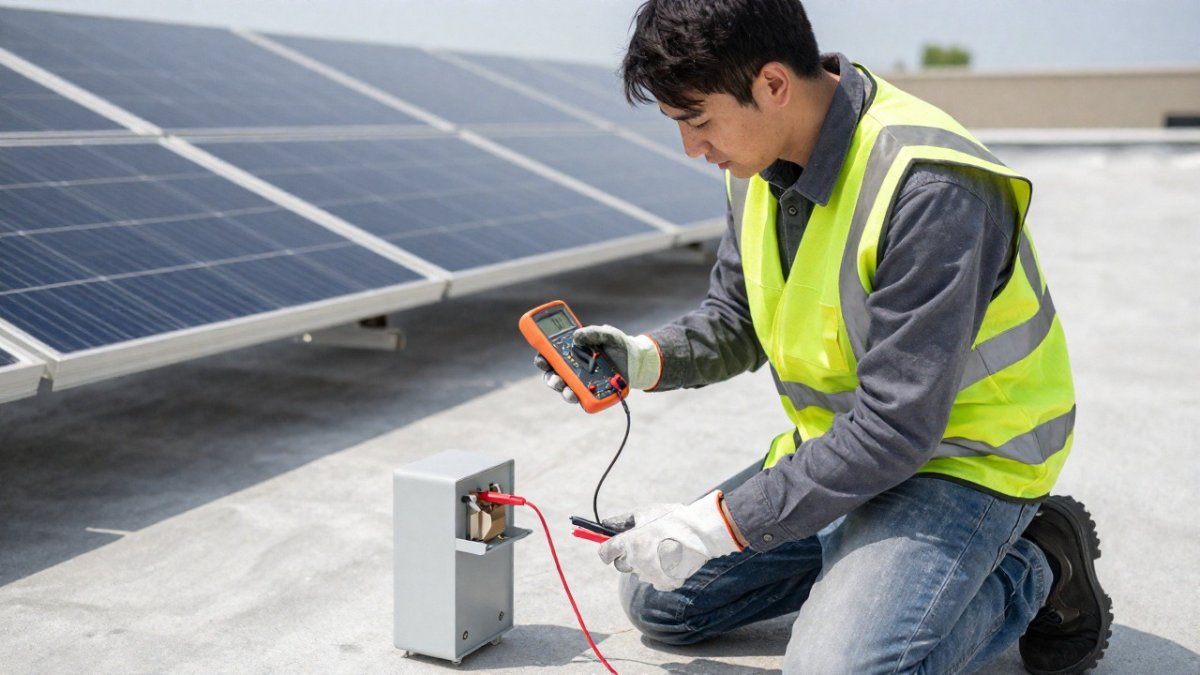
Before you touch a probe, confirm your meter is rated for the voltage you are about to measure.
Here is the safe sequence for one panel, disconnected from the array:
- Cover the panel or work at low light first, a panel in full sun is a live power source even with no load.
- Set the multimeter to DC volts on a range above the panel's Voc.
- Touch the probes to the positive and negative leads to read Voc; note the reading and cell temperature.
- Switch to DC amps and connect the meter in series to read short-circuit current briefly; confirm you are on the right jack.
- Multiply volts by amps for a rough wattage estimate, an upper bound, not a nameplate match.
- Write down the time, weather, irradiance estimate, and instrument model.
A single panel can still produce dangerous DC voltage in full sun, and a DC arc does not trip a standard breaker the way AC does.
Why the Volts-Times-Amps Estimate Is Not Wattage
Voc is measured with no current flowing and Isc with the output shorted, so neither occurs at the maximum power point.
The estimate is still useful for comparison. If you measure the same panel under similar irradiance and temperature a month apart, a drop of more than a few percent in either Voc or Isc is worth investigating: the absolute number matters less than the trend under matched conditions.
Meter Accuracy and Repeatable Documentation
Meter tolerances matter when detecting small declines, so record the meter model and its stated accuracy alongside each reading.
A practical log entry includes date and time, ambient and cell temperature, an irradiance estimate, the panel identifier, Voc, Isc, the calculated product, and the instrument used. Without those fields, two readings taken weeks apart cannot be compared with confidence, and a slow fault can hide inside normal weather variation.
How to Test a Solar Panel Without a Multimeter
Without a multimeter, you can still judge panel health from your monitoring system and your inverter display.
Compare today's output to the same hour on a clear day last month: a sudden drop points to a fault, a slow slide to soiling or degradation.
You can also:
- Check the monitoring app for string-level alerts
- Look for hot spots or discoloration on the panel face
- Confirm no new shade has appeared from trees or new construction
These checks will not give you a voltage reading. They will tell you whether to call someone.
String Faults, Inverter Checks, and Reading Performance Ratio
Performance ratio is a solar PV system metric normalized by both system capacity and incident solar radiation, per the National Renewable Energy Laboratory. In plain terms, it tells you how well your system converts the sunlight it actually receives, after accounting for temperature, soiling, shading, and wiring losses. A performance ratio near the design target means the system is healthy.
A Worked Performance Ratio Example
Suppose a system has a 10 kW DC nameplate capacity and, over a clear day, the irradiance sensor at the array records 5.5 kWh per square meter of incident sunlight. The expected DC energy at standard test conditions would be 10 kW times 5.5 hours, or 55 kWh. If the inverter reports 44 kWh delivered that day, the performance ratio is 44 divided by 55, or 0.80, 80 percent.
The pattern matters more than the number: if the same system ran at 82 percent last month under similar irradiance and now runs at 76 percent, the six-point drop is the signal. That is why you record irradiance and temperature with every reading.
Separating Weather and Season From Real Faults
Output falls for reasons that are not faults: cell temperature above 25°C, winter sun angles, and hazy days all lower production without anything being broken.
A system that looks fine in spring but underperforms every summer afternoon often points to a string more sensitive to heat or a partially shaded row that only loses production when the sun is high.
String-Level Diagnostic Sequence
When the performance ratio drops and weather does not explain it, work from the inverter outward:
- Read the inverter's string-level data. Most modern inverters report per-string voltage and current. Compare each string to its siblings at the same moment.
- Look for an outlier string. A string reading noticeably lower current than the others under the same irradiance points to shading, soiling, a failed bypass diode, or a bad connector on that string.
- Check the DC disconnect and combiner. Loose or corroded connectors add resistance and heat; look for discoloration or melted plastic.
- Compare Voc per string to the design spec. A string with low Voc often has an open connection or a failed diode; a string with normal Voc but low current under load often has a shading or soiling problem.
- Confirm the inverter's AC output and error log. A tripped breaker or a derated inverter shows up here, not at the panels.
- Recheck after cleaning or reconnecting. If the outlier string recovers, the cause was soiling or a connection; if it does not, the fault is in the panel or wiring.
Long-term monitoring is the only way to catch slow faults. The SunSpec Alliance notes that degradation, intermittent faults, outages, and low-light problems often show up only over time, not in a single test.
If you want to see how ongoing monitoring ties to your lease terms, review solar installation maintenance and who handles what after install.
What Solar Panel System Performance Testing Costs
Solar panel system performance testing cost depends on system size, access, and whether you need a full commissioning audit or a single diagnostic visit. Pricing depends on scope, so visit Go Solar DMV's website for current pricing or to request a quote.
What drives the number:
- System size: more strings and panels take longer to test
- Roof access: steep or complex roofs add labor
- Documentation: a signed report with logged readings takes more time than a verbal check
Ask any provider for a written scope before you agree. For a fuller picture of what an inspection includes, read our residential solar installation audit guide.
When to Call a Licensed Solar Professional
Call a licensed solar professional any time testing requires opening a disconnect, probing live DC conductors, or diagnosing a fault you cannot see from the monitoring app.
Signs it is time to call:
- Your production dropped sharply and stayed down
- The inverter shows a fault code you do not recognize
- You see burn marks, melted plastic, or water inside a junction box
Before you hire anyone, verify their credentials. Our guide on what credentials a solar installer should have covers licensing and certification checks. And if monitoring hardware is part of your decision, the $0-down solar lease to own page explains how a maintained system tracks performance for you.
Get a Free Performance Review Before You Sign Anything
Testing tells you what your system is doing. It does not tell you whether the quote in front of you is fair.
That is where we come in. Go Solar DMV helps homeowners across Virginia, Maryland, and the District compare solar quotes with real data instead of sales talk.
Do not sign until the numbers make sense. Visit Go Solar DMV to learn more about getting started before you commit.
Frequently Asked Questions
How do you test solar panel performance?
Start with the system's monitoring data and compare measured output against expected output for the irradiance and temperature at that moment. A full solar panel testing pass adds open-circuit voltage and short-circuit current readings at the string level, an inverter check, and a visual inspection for shading, soiling, and hot spots. Performance Ratio is output normalized by both system capacity and incident solar radiation, which is a fair way to compare a system against its own design specification rather than against a neighbor's array.
How much does solar panel system performance testing cost?
Solar panel system performance testing cost varies with system size, roof access, and how many strings need to be measured, so no single figure applies to every home. A basic monitoring review and visual inspection sits at the low end; a full commissioning-style audit with string-level measurements, inverter diagnostics, and a written report sits higher. Ask for a scope in writing before booking, and confirm whether the report includes weather-adjusted expected output so you can judge results months later.
Can you test a solar panel without a multimeter?
Yes, within limits. Your inverter's monitoring portal or app shows real-time power output, and comparing that figure to the system's rated wattage on a clear midday gives a rough health check. You can also watch for sudden drops, check the inverter's fault log, and inspect panels for shade, debris, or discoloration. What you cannot do without a meter is measure open-circuit voltage or short-circuit current directly, so any fault inside a string still needs a qualified technician with proper test equipment.
How often should a solar panel system be tested?
Review monitoring data monthly and book a professional inspection every two to three years, or sooner if output drops noticeably. Long-term assessment is what reveals degradation, intermittent faults, outages, and low-light performance problems that a single short-term reading will miss. Gradual decline is typical with age, but a sudden step down is not and warrants a string-level check.
