Which Battery Chemistry Is Best for Home Solar?
Quick Summary
Lithium iron phosphate (LFP) is the best fit for most home solar systems, because it offers greater thermal stability, longer cycle life and deeper usable daily cycling than other common chemistries. Nickel manganese cobalt (NMC) packs more energy per pound but depends more on the battery management system and installation quality for safety. Match the battery chemistry to your load profile and backup goals.
- LFP is generally regarded as more thermally stable than NMC for home installs.
- Five of seven batteries in a 2026 roundup used LFP chemistry.
- Compare batteries on usable kWh and warranted cycles, not nameplate capacity.
- Check continuous kW and peak surge ratings against your largest load.
- Ask installers for UL 9540 listing, heat protection and BMS fault response.
Table of Contents
- Why Battery Chemistry Matters for Your Home Solar System
- The Main Battery Chemistries: Lithium-Ion, Lead-Acid and Nickel-Based
- LFP vs. NMC Solar Batteries: Safety, Lifespan and Cost Compared
- Home Solar Battery Lifespan and Degradation Over Time
- Solar Battery Capacity and Backup Duration: Sizing for Your Load
- Best Batteries for Solar Off-Grid Systems
- Choosing Your Chemistry and Scheduling a Site Assessment
- Frequently Asked Questions
Why Battery Chemistry Matters for Your Home Solar System
Last Updated: November 25, 2026
Choosing a battery chemistry for home solar is less about finding one "best" option and more about matching the chemistry to how your household actually uses power. Compare Maryland solar battery storage options, incentives and sizing for your home.
Lithium-ion is the category most homeowners encounter first. Research from Oregon State University's battery-storage research shows that battery storage remains an active area of development, with researchers focused on efficiency, safety and sustainability.
The practical question is simple: which chemistry fits your roof, your electric bill and your backup goals?
The Main Battery Chemistries: Lithium-Ion, Lead-Acid and Nickel-Based
Solar batteries generally fall into a few families. Consumer guides such as EnergySage's guide to solar battery types identify lead-acid, lithium-ion and flow batteries as the three main categories.
Nickel-based chemistries appear in some older or specialty products, but they are less common in modern home systems. Flow batteries exist as well, though they are generally more suited to large commercial or utility projects than to a typical rooftop home.
Keep the main trade-offs in mind as you read:
- Lead-acid: lower upfront cost, heavier, shorter usable life, less usable capacity per unit
- Lithium-ion: higher upfront cost, lighter, longer cycle life, more usable capacity
- Flow and nickel-based: niche options that are rarely the default for a home system
LFP vs. NMC Solar Batteries: Safety, Lifespan and Cost Compared
Within lithium-ion, the two chemistries you will hear about most are lithium iron phosphate (LFP, also written LiFePO4) and nickel manganese cobalt (NMC). LFP is now common in home products. A 2026 product roundup cited by CNTE Power's 2026 solar battery roundup noted that five of its seven featured batteries used LFP chemistry, which signals how widely the chemistry is now offered.
The two chemistries are not interchangeable, and the differences show up in four places: thermal behavior, cycle life, usable capacity and lifetime cost. LFP is generally regarded for longevity and stability, while NMC is generally regarded for higher energy density per pound. Neither is universally "best", the right pick depends on your backup goals and how hard you cycle the battery.
Thermal Stability and Fire Safety
For most homeowners, safety comes first. LFP cells are generally regarded as more thermally stable than NMC cells.
That is why chemistry-level risk and product-level risk are different questions.
Watch out: a chemistry described as "safer" does not excuse a skipped permit or a battery mounted against a hot west-facing wall, installation quality drives outcomes as much as cell chemistry.
Cycle Life, Usable Capacity and Efficiency
Cycle life is where LFP and NMC diverge most for homeowners. Warranty cycle counts and capacity guarantees vary by product. Always read the specific product's warranty document, because the capacity guarantee at end of term tells you more than a headline lifespan number.
Usable capacity and depth of discharge (DoD) work alongside cycle life. LFP tolerates deeper daily cycling with less degradation, so a manufacturer can publish a higher usable kWh from the same nameplate rating.
A Like-for-Like Lifetime Cost Framework
Sticker price is the least useful number in a battery quote. To compare LFP and NMC fairly, put every quote on the same basis using five inputs:
- Installed cost, equipment plus labor, permitting and any electrical panel work, in USD.
- Usable energy, the kWh the warranty actually guarantees, not nameplate capacity.
- Warranted cycles or throughput, the cycle count or megawatt-hour throughput the warranty covers.
- Replacement cycles over your horizon, how many times you would need to replace the battery across, say, a 20-year ownership period.
- Warranty capacity guarantee, the percentage of original capacity the manufacturer promises at end of term.
Divide installed cost by (usable kWh × warranted cycles) to get a rough cost per delivered kWh, then add replacement cost if your horizon outlasts the warranty.
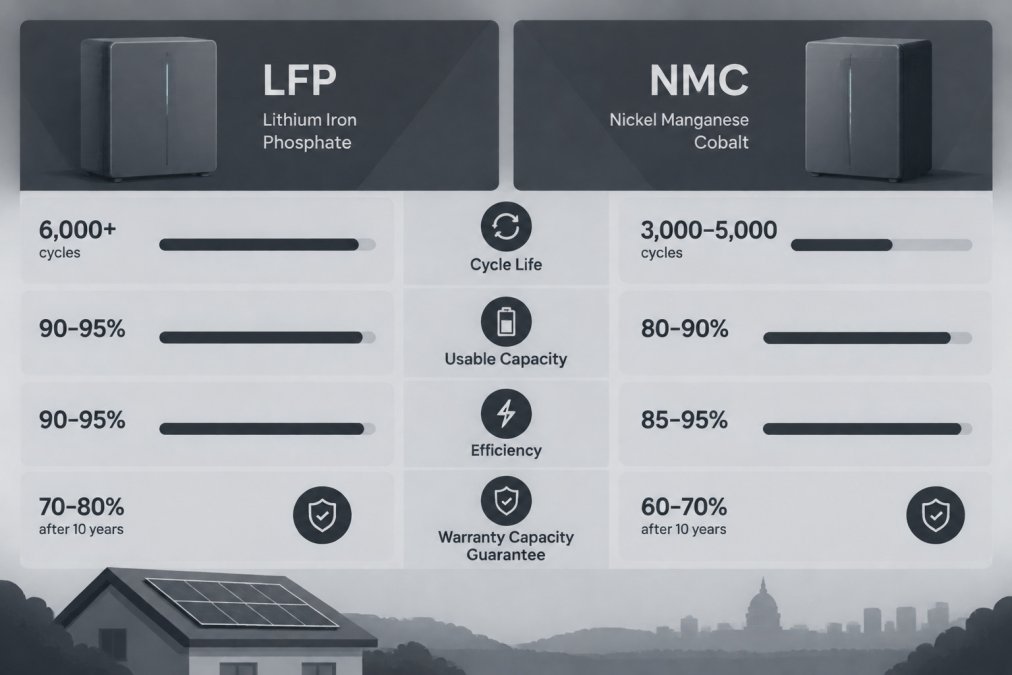
The two lithium chemistries compare as follows on the points that matter most for a home install.
| Factor | LFP | NMC |
|---|---|---|
| Thermal stability | Generally regarded as more stable | Depends more on BMS and installation |
| Cycle life | Generally regarded for longevity | Shorter warranted cycle counts in examples given |
| Usable capacity | Deeper daily cycling, less buffer | Larger buffer reserved, nameplate and usable diverge |
| Energy density | Lower per pound | Generally regarded as higher per pound |
| Share in 2026 roundup | 5 of 7 featured batteries | 2 of 7 featured batteries |
Home Solar Battery Lifespan and Degradation Over Time
Every battery loses some capacity as it ages. How fast that happens depends on chemistry, how deeply the battery is cycled, temperature and how the system is managed. Ask for the warranty's capacity guarantee at the end of the term, since that number tells you more than a headline lifespan figure.
Monitoring helps you track this over time. You can see per-panel production and battery backup status on your phone through the Enphase or Tesla app.
Solar Battery Capacity and Backup Duration: Sizing for Your Load
Capacity is measured in kilowatt-hours (kWh), and it determines how long your home can run on stored power. Power output is measured in kilowatts (kW), and it determines how many appliances can run at once. A battery can have plenty of kWh and still trip offline if you start a well pump, air conditioner or EV charger that exceeds its continuous kW rating, so size both numbers, not just capacity.
Start with your daily usage and the circuits you want to back up, such as the refrigerator, lighting, internet and a few outlets. Then decide how many hours of backup you want. A practical sizing approach looks like this:
- Add up the wattage of the essential loads you want to power.
- Estimate how many hours per day those loads run from the battery.
- Compare that daily energy need to the battery's usable capacity, not its total rated capacity.
- Check the peak kW of the largest load you want to start against the battery's continuous and surge ratings.
A Worked Example
Suppose your essential loads are a refrigerator (about 150 W average), lighting and outlets (about 200 W), internet and router (about 30 W) and a furnace blower (about 400 W). That is roughly 780 W of continuous draw, or about 0.78 kW. Over a 12-hour outage that is roughly 9.4 kWh of usable energy. If you also want to run a window air conditioner at about 1,200 W, the continuous draw rises to about 2 kW and the 12-hour need to roughly 24 kWh, a very different battery.
Match Chemistry to Your Load Profile
Household load profiles fall into a few patterns, and each points toward a different chemistry and sizing strategy:
- Daily cycling, grid-tied (solar self-consumption): The battery charges and discharges most days to shift solar production into the evening. This is the hardest-working profile, so cycle life and round-trip efficiency dominate. LFP's deeper usable depth of discharge and longer cycle warranty usually fit best here.
- Backup-only, rarely cycled: The battery sits full most of the year and runs the house a few times during outages. Cycle life matters less; peak kW, usable capacity and a BMS that handles long idle periods matter more. Either chemistry can work, so compare on installed cost per usable kWh and warranty terms.
- Off-grid or weak-grid: The battery carries the full load through cloudy stretches, so usable capacity, cycle life and cold-weather behavior all matter. LFP is common, but confirm the low-temperature charging limits and whether the system includes thermal management.
Seasonal solar production belongs in the sizing math too. A system that produces well in summer but little in winter will lean on the battery more in the cold months, which is exactly when lithium capacity and charging rates are most constrained. Size for the worst month you intend to ride through, not the best.
Usable Capacity, Depth of Discharge and Oversizing
Usable capacity is the number that matters. A battery rated at 13.5 kWh nameplate may publish a usable figure closer to 13.5 kWh (LFP products often quote usable directly) or reserve a buffer (some NMC products).
Watch out: a quote that lists only nameplate kWh and a headline backup duration, without usable capacity and continuous kW, is not comparable to another quote, ask for both before you sign.
Best Batteries for Solar Off-Grid Systems
Off-grid setups have different needs. Browse off-grid solar and battery power systems for hybrid inverters, charge controllers and backup generators suited to cabins and remote sites. Without a utility connection, the battery must carry the full load through cloudy days, so cycle life and capacity matter even more. Cabins, land and remote structures usually require hybrid inverters, charge controllers and sometimes a backup generator alongside the battery.
Choosing Your Chemistry and Scheduling a Site Assessment
Chemistry is one piece of the decision. Your roof orientation, shading, electrical service and long-term plans for the home all shape which system makes sense. Pricing depends on system size, equipment and your site, so contact Go Solar DMV for a quote specific to your home.
To see how the process works, from the first step through net metering, SREC income and battery backup, read our guide to how going solar works in Virginia, Maryland and D.C.. If you are ready to check whether you qualify for a $0-down option and a utility rate freeze, check your $0-down solar eligibility and rate freeze on our site.
Next steps are straightforward. List your essential loads, decide your backup goal, and ask any installer for usable capacity, warranty terms and an on-site assessment before you commit.
Frequently Asked Questions
What type of battery is best for a home solar system?
Lithium iron phosphate (LFP) is the most common choice for residential solar today. Several 2026 product roundups show LFP in most featured models, and the chemistry is generally valued for its stability and long cycle life. Lead-acid batteries cost less upfront but usually offer fewer usable cycles and less depth of discharge. Nickel-based chemistries are rarely used in home systems. The right answer depends on your budget, backup needs and how often the battery will cycle, so compare specifications for each product rather than relying on chemistry alone.
What is the difference between LFP and NMC solar batteries?
LFP (lithium iron phosphate) and NMC (nickel manganese cobalt) are both lithium-ion chemistries, but they differ in safety and energy density. LFP has a more stable thermal profile and a lower fire risk, and it generally delivers longer cycle life. NMC packs more energy into a smaller footprint, which matters when space is tight. For most homeowners in Virginia, Maryland and Washington, D.C., where space is rarely the constraint, LFP is typically the more practical residential option. Confirm the specific cell chemistry and warranty with the manufacturer before you buy.
How long will a 20 kWh home solar battery last?
Lifespan depends less on the nominal 20 kWh rating than on cycle life, depth of discharge, temperature and how often the battery is charged and discharged. Battery warranties typically state a cycle count or a retained-capacity percentage over a set number of years, so use those figures to estimate service life. Keeping the battery within a moderate temperature range and avoiding deep discharges will extend its useful life. Ask any installer to show the warranty terms for the exact model you are considering.
Are lithium iron phosphate batteries safe for home solar?
LFP batteries are widely regarded as among the safer lithium-ion options for home use because their chemistry is more thermally stable than many other lithium-ion types. They are less prone to thermal runaway, although no battery is risk-free. Proper installation, a compliant enclosure, a battery management system and adherence to local electrical codes all matter. Check that the installer follows the National Electrical Code and any local permitting requirements in your jurisdiction.
