7 Virginia Solar Incentives for Low-Income Households
Last Updated: November 26, 2026
Quick Summary
Virginia low-income households can reach solar incentives through utility income-qualified programs, shared solar, net metering with a reserved low-income share, and weatherization assistance. Eligibility depends on household income relative to household size, the utility serving your address, and whether a reserved slot is still open, which is first-come, first-served.
- Virginia's shared-solar law defines a low-income facility as one with at least 30% of capacity subscribed by low-income customers.
- Net metering capacity is capped at 6% of prior-year peak load, with 1% reserved for low-income customers.
- Weatherization assistance is a separate track from solar and is often approved faster for bill relief.
- Have income documents, a recent utility bill, and household size proof ready before you call your utility.
- Confirm program funding and income limits directly with the utility, since third-party figures may be outdated.
Table of Contents
- Dominion Energy Income and Age Qualifying Solar Program: Who Qualifies
- Free Solar Panels in Virginia: What Is Real and What Is a Misleading Claim
- Virginia Solar Rebates and Grants: Eligibility Thresholds and Funding Status
- How Virginia Net Metering Works for Residential Solar and Low-Income Customers
- Step-by-Step: How to Apply for Virginia Solar Assistance
- Renters, Multifamily Residents and Households Without a Suitable Roof
- Check Your Eligibility and Request a Solar Quote Review
- Frequently Asked Questions
Low-income households in Virginia can reach solar incentives, but the programs are narrower than most homeowners expect. Go Solar DMV has put together this guide to help you see which options exist, who qualifies, and what to do next. The core picture is this: Virginia's shared-solar law sets a clear low-income threshold, and state energy planning is exploring no-upfront-cost models, but a 2024 academic analysis concluded that current incentives are not enough for low- and moderate-income groups to benefit University of San Francisco capstone on community solar programs.
- Virginia defines a "low-income shared solar facility" as one with at least 30% of its capacity subscribed by low-income customers or subscribers Virginia Legislative Information System, Chapter 670 (2026)
- Virginia's 2026 Energy Plan describes Pay As You Save, a model that installs energy solutions at no upfront cost and ties repayments to the improvements 2026 Virginia Energy Plan
- Net metering capacity is capped at 6% of the prior year's peak load, with 1% reserved for low-income customers, on a first-come, first-served basis EnergySage, Virginia Solar Incentives 2026
Watch out: Availability is limited and first-come, first-served, so a reserved slot can fill before you apply.
Dominion Energy Income and Age Qualifying Solar Program: Who Qualifies
Utility-run solar assistance in Virginia is not a single program with one income cutoff. It is a set of income-qualified offerings, and the qualifying rules differ by program, by utility territory, and by whether the household is an owner or a renter. The most useful way to read this section is as a checklist of the criteria that actually decide eligibility, plus the documents that prove each one.
The four criteria that decide most cases
-
Income relative to household size. Income-qualified programs compare gross household income to a percentage of the area median income (AMI) or to a state low-income threshold. The threshold rises with each additional household member, so a family of five can qualify at a higher dollar income than a single adult. Ask the utility which threshold it applies, 60% AMI, 80% AMI, and state low-income definitions are all used across different programs, and confirm the number for your exact household size before you apply.
-
Age or disability status, where the program requires it. Some utility assistance is reserved for older adults or customers with a documented disability, and those programs often have a separate application and a separate waiting list. Age-qualified does not mean income-qualified is waived; both tests usually apply.
-
Account and territory. The program is administered by the electric utility serving your address, so eligibility depends on which utility you buy power from and whether your account is residential. Renters can qualify for bill-credit and community-solar programs even when they cannot host panels.
-
Home condition and ownership, for installation programs. If the benefit is a rooftop system, the home must be owned by the applicant and the roof must pass a site assessment for condition, orientation, and shade. A household can be income-eligible and still be turned down for a roof that fails the assessment.
Documents to have ready before you call
Applications can stall on paperwork as often as on eligibility. Gather these first: proof of identity, your most recent utility bill showing the service address and account number, income documentation for every adult in the household (pay stubs, benefit award letters, or prior-year tax return), proof of household size, and, for age- or disability-qualified programs, documentation of that status. For installation programs, add proof of homeownership.
What the program typically covers, and what it does not
Income-qualified solar assistance generally funds the system itself or a subscription to shared solar, and may include the installation and ongoing maintenance. It usually does not fund roof repair, electrical panel upgrades, or tree removal, even when those are needed before panels can go on. Weatherization and energy-efficiency assistance is a separate track that funds insulation, air sealing, and heating and cooling repairs.
How the process actually runs
A common pattern is: pre-screen by phone or online, submit income documentation, receive a site assessment if the benefit is a rooftop system, then wait for a reserved slot to open. Because capacity is limited and first-come, first-served, the pre-screen date can matter as much as the approval date. Ask the utility to confirm in writing where your application sits in the queue.
Watch out: income limits and program windows change, and a threshold quoted on a third-party site may be a year out of date, confirm the current figure and the current application window directly with the utility's assistance team before you plan around it.
Free Solar Panels in Virginia: What Is Real and What Is a Misleading Claim
Offers for "free" solar panels usually mean no upfront payment, not no cost at all. Under a lease or power purchase agreement, you pay a monthly amount for the system's output, and under a loan you repay over time. Read the contract for escalator clauses, transfer terms and what happens if you sell the home.
Go Solar DMV offers rooftop solar with a system installed and maintained at no cost under the structures we offer, but the terms of any agreement should always be reviewed in writing before you sign.
Virginia Solar Rebates and Grants: Eligibility Thresholds and Funding Status
The word "rebate" gets used loosely in solar marketing, and that looseness is where low-income households lose money. Before you count any incentive, sort it into one of three buckets, because they have different eligibility rules, different application paths, and different timing.
Bucket 1: Programs that fund solar hardware. These pay for panels, a shared-solar subscription, or both. The Virginia Solar program, which has reported its 100th installation with participating families saving an average of $73 per month on electricity bills, is also a hardware program Habitat for Humanity Virginia, Solar program.
Bucket 2: Weatherization and efficiency assistance. These programs do not install panels. They fund insulation, air sealing, duct repair, and heating and cooling replacements, and they are usually the faster approval for a household that needs bill relief now.
Bucket 3: Bill relief and rate discounts. These reduce what you owe each month without funding any equipment. They are the right first call for a household that cannot wait for a solar slot, and they can often be stacked with Bucket 1 or 2 benefits.
The federal credit is not a rebate
The residential clean energy tax credit is a credit against federal income tax, not an upfront discount.
Stacking rules in plain terms
Upfront grants and bill credits from Bucket 1 or 3 can generally be combined with the federal tax credit, but the credit is calculated on your remaining cost after those benefits, so you cannot double-count the same dollar. Utility rebates and state programs may each have their own non-duplication language. The safe move is to ask each program administrator, in writing, whether their benefit reduces the basis for any other benefit you are receiving.
How to check funding status without getting misled
Third-party incentive directories are useful for orientation but go stale. Verify in this order: the utility's own assistance page for income-qualified programs, the state energy office for grant-funded programs, and the program administrator named in your award letter.
A dated status check
For full statutory detail on current Virginia solar incentives, see our Virginia Solar Incentives, SRECs & Tax Credits overview.
The article sorts incentives into three buckets, each with different eligibility rules and timing.
| Bucket | What it covers | Key point |
|---|---|---|
| Solar hardware programs | Panels, shared-solar subscriptions | Rarest and most capacity-constrained |
| Weatherization and efficiency | Insulation, air sealing, duct repair, heating and cooling | Usually faster approval for bill relief |
| Bill relief and rate discounts | Lower monthly bills, no equipment funded | Can often be stacked with other benefits |
| Federal clean energy tax credit | Credit against federal income tax | Not an upfront discount; may not be fully usable |
How Virginia Net Metering Works for Residential Solar and Low-Income Customers
Net metering credits the excess power your panels send to the grid against the power you draw later. Virginia's program is capped, and a share of that capacity is reserved for low-income customers, so the reserved slice fills first-come, first-served.
Net metering helps most when your system produces more than you use across the billing period. Homes with high daytime consumption or shade issues may see smaller credits, so ask for a production estimate before deciding.
Step-by-Step: How to Apply for Virginia Solar Assistance
Follow these steps to move from research to application:
- Confirm your income and household size against the program's current limits.
- Contact your electric utility and ask whether a low-income reserved slot is open.
- Get a site assessment covering roof condition, orientation and shade.
- Request written terms, including the price, term length and any escalator clause.
- Compare at least two quotes and confirm which incentives are included.
- Sign only after you understand the repayment or lease obligations.
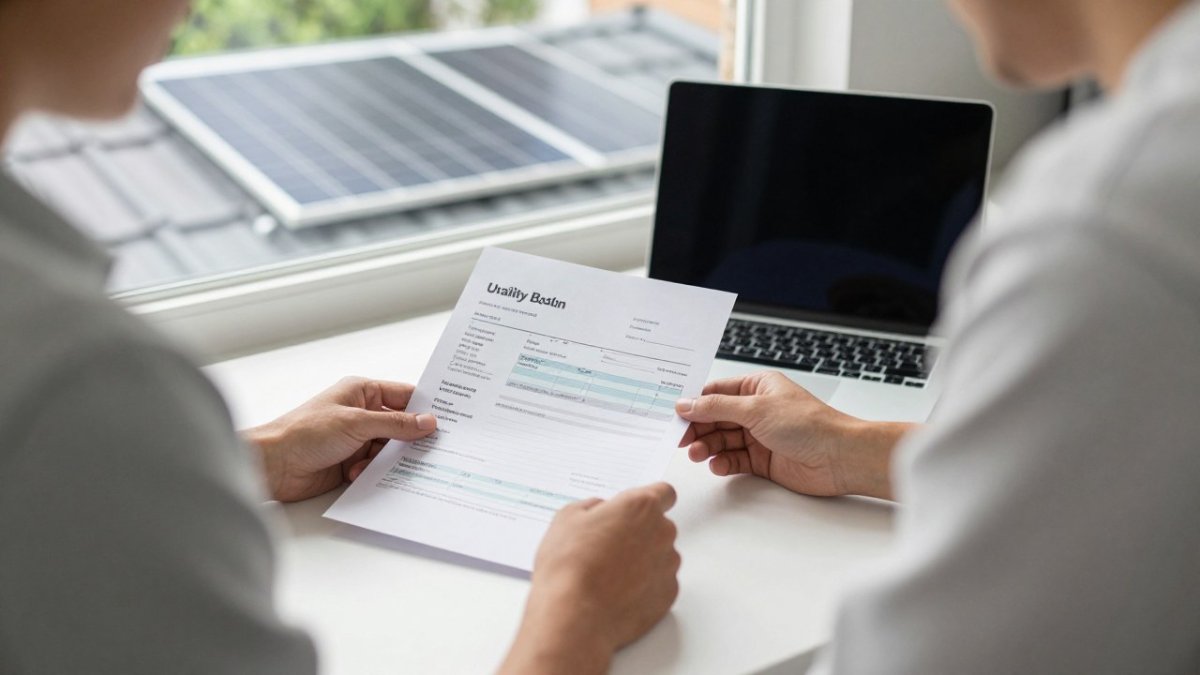
!A homeowner at a kitchen table reviewing a utility bill and paperwork beside a laptop, with a rooftop solar panel visible through a window
Renters, Multifamily Residents and Households Without a Suitable Roof
If you rent or live in a multifamily building, rooftop panels may not be an option. Community solar lets you subscribe to a share of a larger project and receive credits on your bill, with no panels at home. Go Solar DMV's community solar program covers Virginia, Maryland and D.C.
Use the Solar Roof Score tool to check whether your roof gets enough sun before deciding on rooftop panels.
Check Your Eligibility and Request a Solar Quote Review
Start by checking your income against the current low-income thresholds, then confirm your roof's sun exposure and your utility's net metering terms. If you want a second opinion on the numbers, learn how to check solar panel eligibility in Virginia step by step, or review getting solar with no money down options before you commit.
Go Solar DMV can compare your quotes and explain the terms. Visit our website to request a review.
Frequently Asked Questions
Are there any free solar panel incentives available in Virginia?
Some Virginia programs aim to bring solar to low-income households at little or no cost to the homeowner. The most reliable route is a utility or state-sanctioned program such as Dominion Energy's income and age qualifying solar program, or a community or shared solar project that guarantees bill savings. Offers that promise free panels with no eligibility check should be verified directly with the program administrator before you sign anything.
Who qualifies for Dominion Energy's income- and age-qualifying solar program?
Eligibility for income- and age-qualifying programs depends on household income relative to the federal poverty guidelines, household size, and in some cases age or disability status. Because program rules and funding levels change, check the current eligibility requirements on Dominion Energy's website or with the program administrator before applying. Gathering recent income documents and proof of residency in advance speeds up the application.
Does Virginia offer solar rebates or grants for low-income households?
Virginia has offered low-income solar support through state and federal programs, including funding under the federal Solar for All program. Availability changes over time, and some funding status claims conflict across sources, so confirm current availability with the Virginia Department of Energy or your utility before relying on a specific rebate or grant amount.
How can I tell whether a Virginia solar incentive offer is legitimate?
Legitimate offers name the program, its administrator, and the eligibility rules in writing, and they do not require large upfront payments to qualify. Be cautious of offers that pressure you to sign immediately or hide fees in financing terms. Go Solar DMV can help you compare quotes and review contract details on our website before you commit.
